
Consensus Mechanism

Consensus Mechanism: How Networks Agree

Consensus mechanisms solve the fundamental problem of getting thousands of independent computers to agree on a single version of truth without central authority.

A consensus mechanism is the process by which a distributed network of nodes agrees on the validity of transactions and the current state of the blockchain. It ensures all participants have the same version of the ledger without needing to trust each other.

How Consensus Mechanisms Work

Byzantine Fault Tolerance addresses the challenge of reaching agreement when some network participants might be malicious or unreliable. Consensus protocols must work even with bad actors present.

Economic incentives encourage honest behavior through rewards for following protocol rules and penalties for attempting to cheat or attack the network.

Different approaches trade off between security, speed, and energy consumption. No consensus mechanism is perfect – each makes compromises based on network priorities.
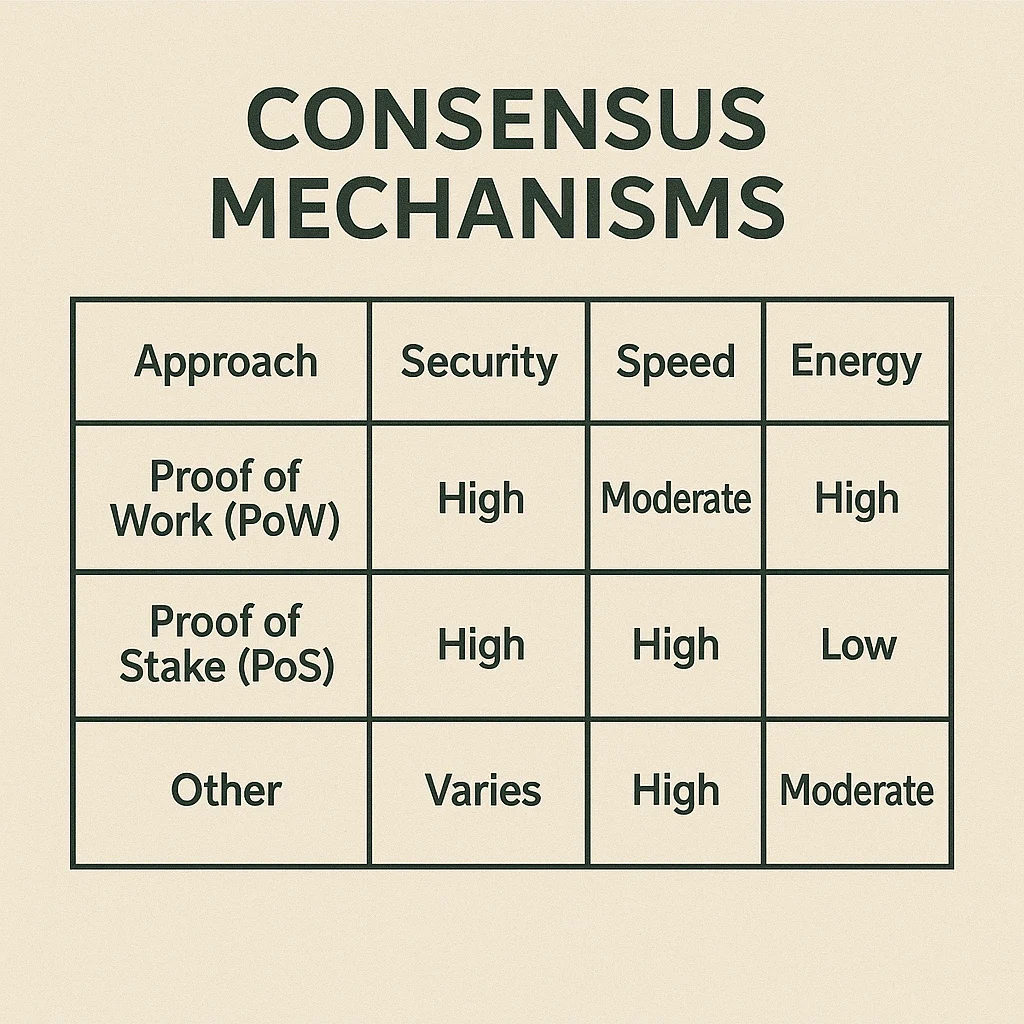
Infographic table comparing Proof of Work (PoW), Proof of Stake (PoS), and Other consensus mechanisms by security, speed, and energy usage

Real-World Examples

  • Proof of Work – Bitcoin’s energy-intensive but proven secure consensus mechanism
  • Proof of Stake – Ethereum’s switch to more energy-efficient validation through economic staking
  • Delegated Proof of Stake – EOS and other networks using representative validation systems

Why Beginners Should Care

Consensus choice fundamentally affects a blockchain’s security, decentralization, and environmental impact. Understanding these trade-offs helps evaluate different cryptocurrency projects.

Network security depends on consensus mechanism design and adoption. Newer or experimental consensus methods may have undiscovered vulnerabilities.

Energy debates often center on consensus mechanisms, with Proof of Work consuming significant electricity while alternatives use far less energy but have different security assumptions.

Related Terms: Proof of Work, Proof of Stake, Validator, Mining

Back to Crypto Glossary

Similar Posts

  • Storage Refund

    Storage Refund: Incentivizing Data CleanupStorage refund mechanisms return gas fees to users who clean up blockchain storage by removing unnecessary data. It's like getting a deposit back when you return empty bottles.Storage refund refers to mechanisms that provide gas fee rebates or payments to users who free up blockchain storage space by deleting data or…

  • Ethereum

    Ethereum: The Smart Contract PlatformEthereum is the blockchain platform that pioneered smart contracts and hosts most decentralized applications. It's like the operating system for programmable money and decentralized apps.Ethereum is a decentralized blockchain platform that enables smart contracts and serves as the foundation for thousands of decentralized applications (dApps). It introduced programmable money and became the…

  • Node Operator

    Node Operator: Network Infrastructure Providers Node operators run the computers that power blockchain networks. They’re the internet service providers of crypto – invisible but essential infrastructure. A node operator is an individual or organization that runs blockchain network infrastructure by maintaining nodes that validate transactions, store data, and relay information. They provide the computational backbone…

  • Multisig Recovery

    Multisig Recovery: Getting Back Lost Access Multisig recovery helps regain access to multi-signature wallets when some keys are lost or compromised. It’s like having spare keys for your house, but with cryptographic mathematics. Multisig recovery refers to mechanisms that restore access to multi-signature wallets when the required number of signatures is no longer available due…

  • Transaction Approval

    Transaction Approval: Authorizing Blockchain ActionsTransaction approval is the process of authorizing blockchain operations through wallet signatures or smart contract permissions. It's like signing checks, but with permanent consequences.Transaction approval involves granting permission for blockchain operations through cryptographic signatures, smart contract interactions, or delegation mechanisms. These approvals authorize spending, contract execution, or account access.How Transaction Approval WorksSignature…

  • |

    Bridgeless Interop

    Bridgeless Interop: Direct Cross-Chain Communication Bridgeless interoperability enables direct communication between blockchains without traditional bridge infrastructure. It’s like having chains that can talk directly to each other instead of using translators. Bridgeless interoperability refers to cross-chain communication methods that don’t rely on traditional bridge protocols, instead using native blockchain features or specialized infrastructure for direct…