
Cold Storage

Cold Storage: Maximum Security for Crypto Assets

Cold storage keeps cryptocurrency private keys completely offline, away from any internet connection. It’s the digital equivalent of storing gold bars in a bank vault rather than your wallet.

Cold storage refers to keeping cryptocurrency private keys on devices or media that have never been connected to the internet. This creates an “air gap” that makes remote hacking impossible since attackers cannot access offline storage remotely.

How Cold Storage Works

Offline key generation creates private keys on devices that have never touched the internet, ensuring the keys cannot be intercepted during creation.

Physical security becomes paramount since attackers would need physical access to steal funds, shifting security from cybersecurity to traditional physical protection.

Transaction signing happens offline, with signed transactions transferred to online devices for broadcast without exposing private keys to internet-connected systems.
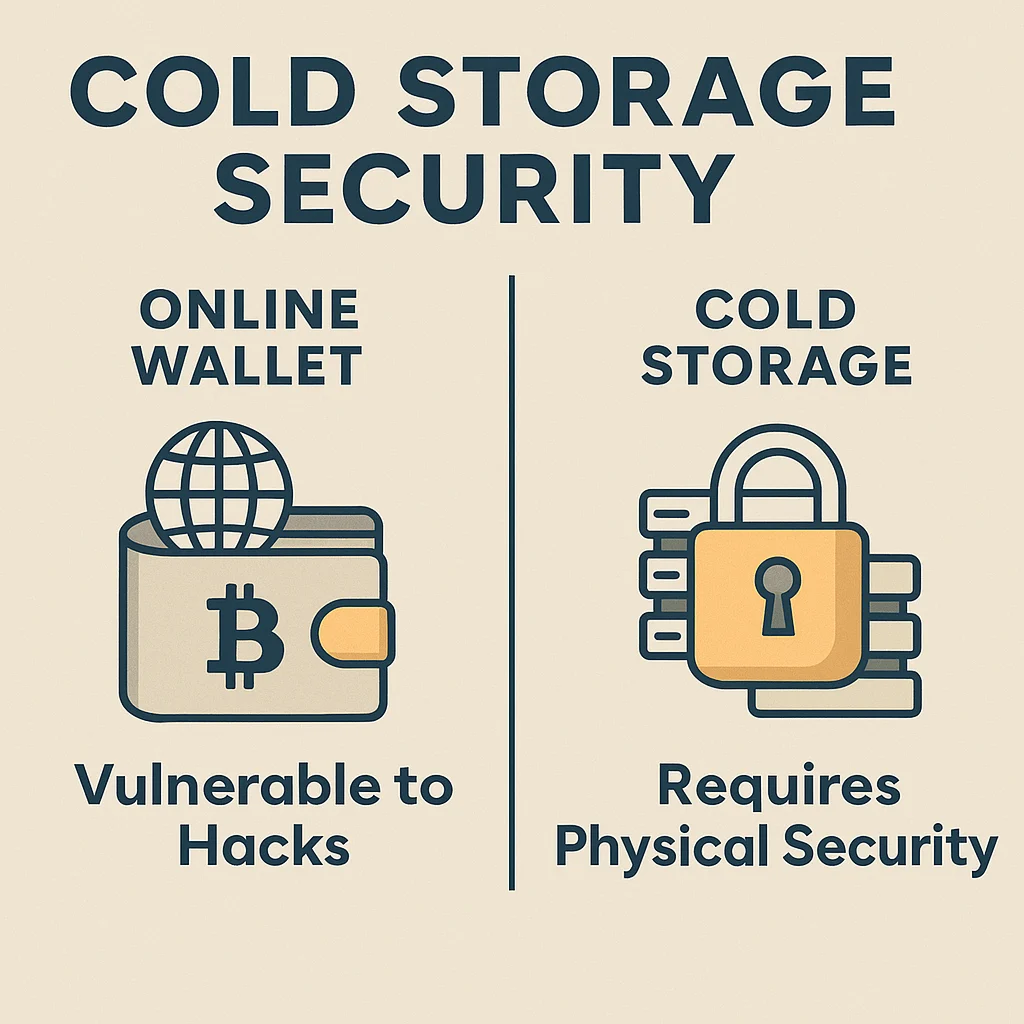
Infographic comparing online wallet vulnerability to hacks with cold storage requiring physical security for crypto assets

Real-World Examples

  • Hardware wallets like Ledger and Trezor provide convenient cold storage for most users
  • Paper wallets store private keys as printed QR codes or written text
  • Steel backups engrave seed phrases on metal plates for fire and flood resistance

Why Beginners Should Care

Exchange hacks happen regularly, making cold storage essential for significant cryptocurrency holdings that you can’t afford to lose completely.

Insurance limitations mean most cold storage losses from user error or theft are not recoverable, making proper setup and backup procedures critical.

Convenience trade-offs exist since cold storage requires more steps for transactions compared to hot wallets, but security benefits usually justify the inconvenience.

Related Terms: Hardware Wallet, Hot Wallet, Private Key, Seed Phrase

Back to Crypto Glossary

Similar Posts

  • Metaverse

    Metaverse: Digital Worlds Meet Real Money The metaverse promises persistent digital worlds where your avatar’s clothes cost more than your real ones. It’s part virtual reality, part speculation, part genuine innovation. The metaverse refers to interconnected virtual worlds where users can work, play, socialize, and own digital assets through avatars and blockchain-based economies. Think Ready…

  • Parabolic

    Parabolic: Exponential Price MovementParabolic describes extremely rapid price increases that follow exponential growth curves, often unsustainable in the long term. It's like a rocket shooting straight up into the sky – impressive to watch but likely to come back down eventually.Parabolic refers to price movements that follow exponential growth patterns, characterized by accelerating increases that…

  • Hash Function

    Hash Function: One-Way Mathematical TransformationHash functions are mathematical algorithms that convert input data into fixed-size output strings in a way that's easy to compute forward but practically impossible to reverse. They're like digital fingerprints for data.A hash function is a mathematical algorithm that takes input data of any size and produces a fixed-size output (hash)…

  • Chain Reorg (Reorganization)

    Chain Reorg (Reorganization): Blockchain History Changes Chain reorgs occur when a blockchain adopts a different version of transaction history, potentially reversing confirmed transactions. It’s like time travel, but messier and more expensive. A chain reorganization (reorg) happens when a blockchain network adopts an alternative chain of blocks as the canonical history, potentially reversing previously confirmed…

  • Yield Stacking

    Yield Stacking: Combining Multiple Income StreamsYield stacking involves combining multiple yield-generating strategies to maximize returns on cryptocurrency investments. It's like having several part-time jobs that all pay into the same bank account.Yield stacking refers to the strategy of combining multiple yield-generating opportunities across different protocols, assets, and mechanisms to maximize overall returns. This approach leverages various…

  • LayerZero

    LayerZero: Omnichain Interoperability Protocol LayerZero is an interoperability protocol that enables applications to send messages and transfer assets across different blockchains. It’s like having a universal translator for blockchain networks. LayerZero is a cross-chain communication protocol that enables decentralized applications to operate across multiple blockchains seamlessly. It provides infrastructure for omnichain applications that can access…