
Merkle Tree

Merkle Tree: Efficient Data Verification

Merkle trees enable efficient verification of large datasets without downloading everything. They’re like having a fingerprint for an entire library that proves any book belongs.

A Merkle tree is a binary tree structure where each leaf represents a data element and each branch contains cryptographic hashes of its children. The root hash summarizes the entire dataset, enabling quick verification of any element’s inclusion.

How Merkle Trees Work

Bottom-up hashing combines pairs of data elements into parent hashes, continuing until a single root hash represents the entire tree structure.

Inclusion proofs require only a small subset of hashes (the “Merkle path”) to prove any specific element exists in the tree without revealing other elements.

Tamper detection makes any change to underlying data immediately visible since it would change the root hash, alerting observers to modifications.
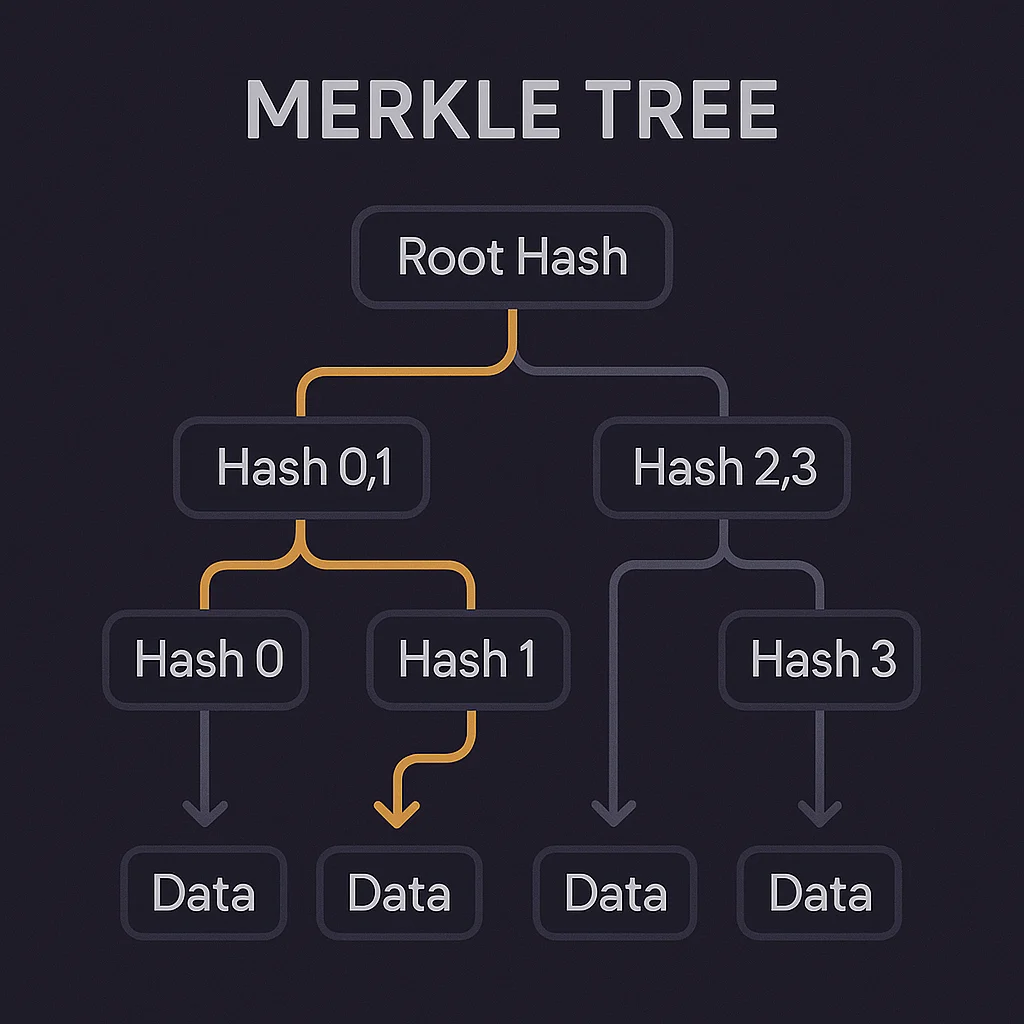
Merkle tree structure showing data blocks at the bottom, combined hashes at each branch, and a root hash at the top with a highlighted path for inclusion proof.]

Real-World Examples

  • Bitcoin blocks use Merkle trees to summarize all transactions in the block header
  • IPFS storage employs Merkle trees for content addressing and verification
  • Airdrop claims often use Merkle trees to efficiently verify eligibility without revealing all addresses

Why Beginners Should Care

Efficient verification allows light clients to verify specific transactions without downloading entire blockchains, enabling mobile and web wallets.

Privacy benefits from Merkle trees let systems prove inclusion without revealing the complete dataset to verifiers.

Scalability foundation for many Layer 2 solutions and blockchain optimizations that need to efficiently prove large amounts of data.

Related Terms: Hash Function, Light Client, Cryptographic Proof

Back to Crypto Glossary

Similar Posts

  • Token Emissions

    Token Emissions: New Cryptocurrency CreationToken emissions refer to the creation and distribution of new cryptocurrency tokens over time according to predetermined schedules. It's like a factory that produces new money at controlled rates rather than printing it all at once.Token emissions describe the systematic creation and release of new cryptocurrency tokens into circulation according to…

  • Token Economics

    Token Economics: Digital Asset Value DesignToken economics encompasses the economic principles and mechanisms that govern cryptocurrency token value, distribution, and utility. It's like designing the economic system for a digital nation.Token economics (tokenomics) refers to the study and design of economic systems around cryptocurrency tokens, including supply mechanisms, distribution models, utility functions, and incentive structures. Good…

  • Sybil Attack

    Sybil Attack: Fake Identity Manipulation Sybil attacks involve creating multiple fake identities to gain disproportionate influence in networks that assume one person equals one vote. It’s like stuffing the ballot box with imaginary voters. A Sybil attack is when an individual or entity creates multiple fake identities to gain unfair influence over a network, voting…

  • Price Discovery

    Price Discovery: Finding Fair Market ValuePrice discovery is the process by which markets determine the fair value of assets through buyer and seller interactions. It's like a continuous auction where everyone votes with their money.Price discovery refers to the mechanism by which markets establish asset prices through the interaction of supply and demand from buyers…

  • Payment Channel

    Payment Channel: Off-Chain Transaction RoutingPayment channels enable fast, cheap cryptocurrency transactions between parties without recording every transaction on the blockchain. They're like running a tab at a restaurant instead of paying for each item separately.A payment channel is an off-chain mechanism that allows two parties to conduct multiple cryptocurrency transactions without broadcasting each one to…

  • Interoperability

    Interoperability: Blockchain Networks Working TogetherInteroperability enables different blockchain networks to communicate and share information seamlessly. It's like having universal translators for blockchain languages.Interoperability refers to the ability of different blockchain networks to communicate, share data, and interact with each other without requiring centralized intermediaries. This enables cross-chain applications and unified user experiences.How Blockchain Interoperability WorksCross-chain protocols enable…