
Slippage

Slippage: The Cost of Market Impact

Slippage is the difference between expected and actual trade prices. It’s the tax you pay for moving markets when your trade is large relative to available liquidity.

Slippage occurs when the execution price of a trade differs from the expected price due to market movement or insufficient liquidity. Large trades relative to available liquidity create more slippage as they consume multiple price levels.

How Slippage Works

Order book depth determines slippage for traditional exchanges. Large trades consume multiple price levels, with each level offering worse prices than the previous one.

AMM slippage follows mathematical curves where larger trades cause more price impact. A $1000 swap might have 0.1% slippage while a $100,000 swap has 5% slippage.

Market volatility can cause slippage even on small trades when prices move significantly between order submission and execution.
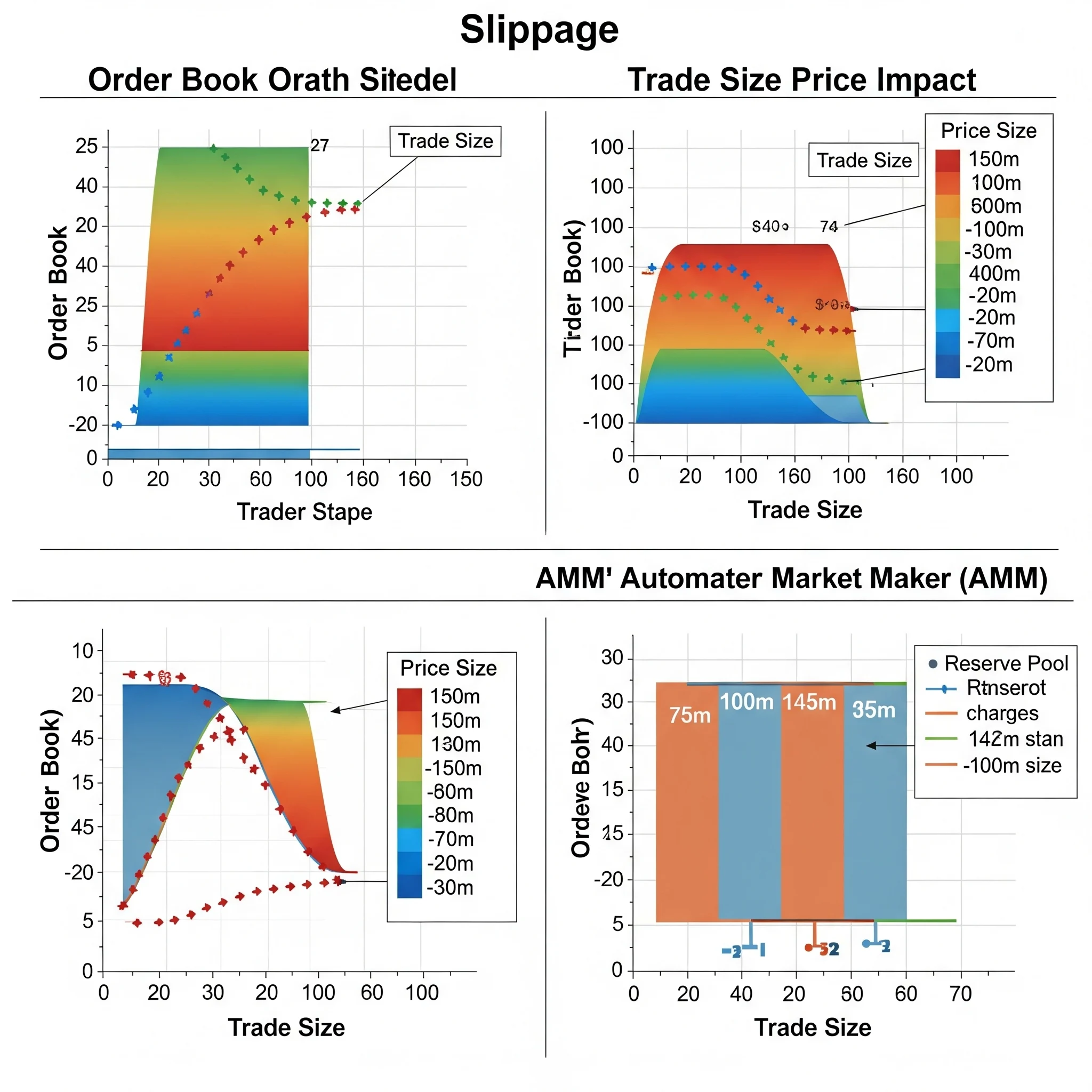
Visualization showing slippage in crypto trading, comparing price impact on order book and AMM models for different trade sizes.

Real-World Examples

  • Large DEX trades on Uniswap can face 5-10% slippage during low liquidity periods
  • Memecoin trading often has extreme slippage due to shallow liquidity pools
  • Front-running bots can increase slippage by trading ahead of pending transactions

Why Beginners Should Care

Hidden costs from slippage can exceed visible trading fees, especially for larger trades or illiquid token pairs with shallow liquidity.

Slippage tolerance settings protect against excessive price impact but may cause transaction failures if markets move beyond acceptable ranges.

Timing matters for reducing slippage – trading during high liquidity periods or splitting large orders into smaller chunks can minimize price impact.

Related Terms: Liquidity, AMM, Price Impact, MEV

Back to Crypto Glossary

Similar Posts

  • Ring Signatures

    Ring Signatures: Anonymous Signatures in Groups Ring signatures let any member of a group sign a message without revealing which specific member created the signature. It’s like having a family photo where you know someone took it, but can’t tell who. A ring signature is a cryptographic signature scheme where any member of a group…

  • Consensus Rules

    Consensus Rules: Network Agreement ProtocolsConsensus rules define how blockchain networks validate transactions and maintain agreement about the ledger state. They're like the constitution for digital money systems.Consensus rules are the specific protocols and requirements that all network participants must follow to validate transactions, create blocks, and maintain agreement about the blockchain's current state. These rules ensure…

  • Token Burn

    Token Burn: Destroying Supply for Value Token burns permanently remove cryptocurrency from circulation by sending it to addresses where it can never be recovered. It’s digital deflation in action. Token burn is the permanent removal of cryptocurrency tokens from circulation by sending them to an unusable address or smart contract that destroys them. This reduces…

  • Self-Custody

    Self-Custody: Direct Asset ControlSelf-custody means personally controlling your cryptocurrency private keys rather than trusting third parties to hold your assets. It's like keeping cash in your own safe instead of depositing it in someone else's bank account.Self-custody refers to the practice of personally maintaining control over cryptocurrency private keys and digital assets without relying on…

  • Network Congestion

    Network Congestion: Blockchain Traffic JamsNetwork congestion occurs when cryptocurrency networks become overloaded with transaction requests, causing delays and increased fees. It's like rush hour traffic that slows everyone down and costs more to navigate.Network congestion refers to periods when cryptocurrency networks receive more transaction requests than they can process efficiently, resulting in delayed confirmations and…

  • Sanctions

    Sanctions: Government Financial RestrictionsCryptocurrency sanctions involve government restrictions on specific addresses, entities, or services to prevent them from accessing financial systems. They're economic weapons adapted for the digital age.Sanctions refer to government-imposed restrictions that prohibit individuals, entities, or services from accessing financial systems or conducting specific activities. In crypto, this includes blocking addresses and restricting access…