
MEV (Maximal Extractable Value)

MEV (Maximal Extractable Value): The Hidden Tax on DeFi

MEV is the extra profit that miners and validators can extract by reordering, including, or excluding transactions within blocks. It’s like cutting in line at the blockchain cafeteria.

Maximal Extractable Value (MEV) is the additional profit that block producers can capture by strategically ordering transactions, beyond standard block rewards and fees. This creates an invisible tax on DeFi users through front-running, sandwich attacks, and arbitrage extraction.

How MEV Works

Transaction ordering power lets miners and validators see pending transactions and arrange them to maximize their profit, often at the expense of regular users.

Front-running involves placing transactions ahead of known profitable trades to capture arbitrage opportunities or cause slippage for the original trader.

Sandwich attacks place transactions before and after target trades to manipulate prices and extract value from the victim’s transaction through artificial slippage.
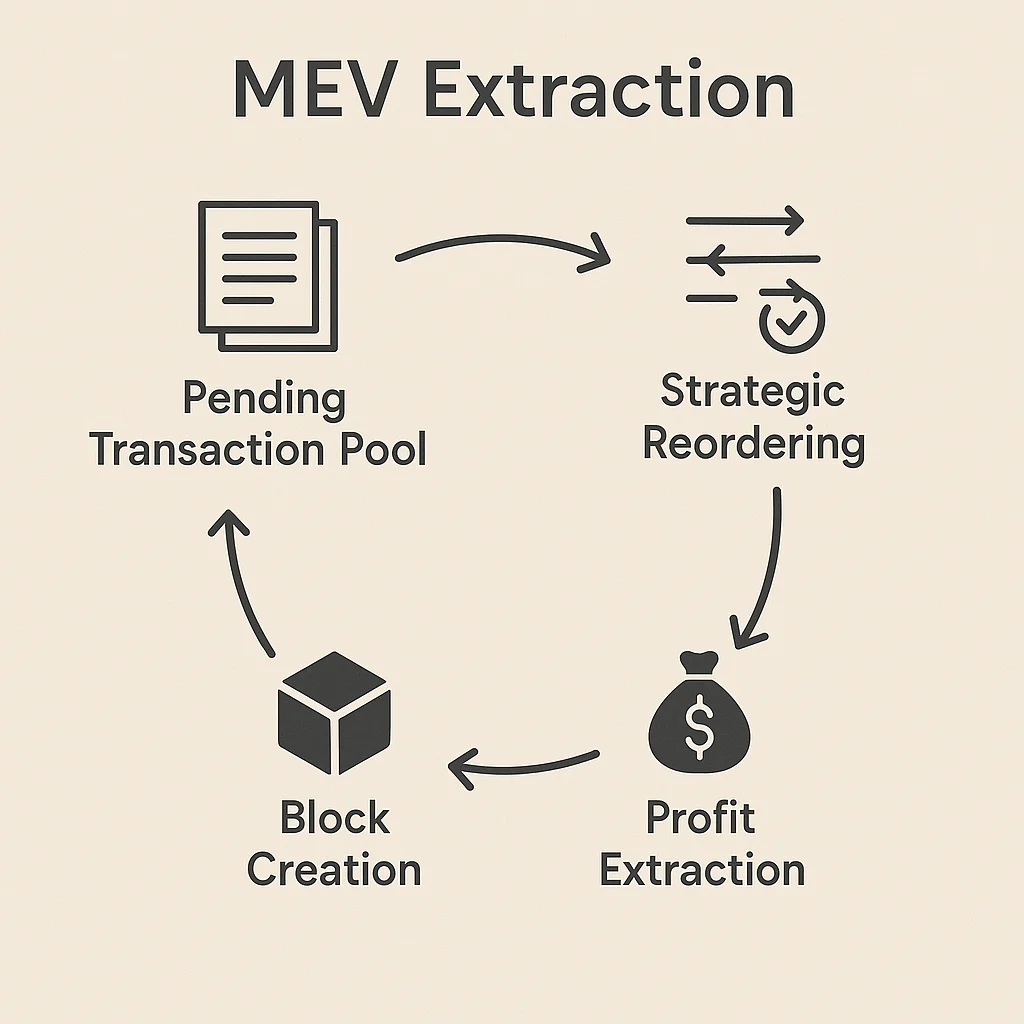
Infographic showing MEV extraction process: pending transaction pool, strategic reordering, profit extraction, and block creation

Real-World Examples

  • DEX arbitrage bots extract millions daily by front-running price differences between exchanges
  • Liquidation sniping involves front-running liquidation transactions to capture discounted collateral
  • NFT sniping uses MEV to front-run popular NFT purchases and flip for immediate profit

Why Beginners Should Care

Hidden costs from MEV can significantly increase the real cost of DeFi transactions beyond visible gas fees through increased slippage and worse execution prices.

Protection strategies include using private mempools, MEV-protected RPC endpoints, or protocols specifically designed to prevent MEV extraction.

Ecosystem impact sees billions in value extracted from regular users annually, raising questions about fairness and sustainability of current blockchain designs.

Related Terms: Front-Running, Sandwich Attack, Slippage, DeFi

Back to Crypto Glossary

Similar Posts

  • Network Decentralization

    Network Decentralization: Distributed Control ArchitectureNetwork decentralization refers to distributing control and operation of blockchain networks across many independent participants rather than concentrating power. It's like having a town where decisions are made by all residents voting together instead of a single mayor controlling everything.Network decentralization describes the distribution of control, validation, and governance functions across…

  • Ring Signatures

    Ring Signatures: Anonymous Signatures in Groups Ring signatures let any member of a group sign a message without revealing which specific member created the signature. It’s like having a family photo where you know someone took it, but can’t tell who. A ring signature is a cryptographic signature scheme where any member of a group…

  • Wei

    Wei: Ethereum's Smallest UnitWei is the smallest denomination of Ethereum, similar to how cents are the smallest unit of dollars. It's like measuring distances in millimeters when you need precision, even though we usually think in meters or kilometers.Wei represents the smallest possible unit of Ethereum (ETH), with one ETH equal to 1,000,000,000,000,000,000 (10^18) wei. This…

  • Soulbound Token (SBT)

    Soulbound Token (SBT): Non-Transferable Achievements Soulbound tokens are NFTs that cannot be transferred or sold once received. They represent achievements, credentials, or identity elements that should remain permanently attached to specific individuals. A Soulbound Token (SBT) is a non-fungible token that is permanently bound to a specific wallet address and cannot be transferred or sold….

  • Cross-Chain Protocol

    Cross-Chain Protocol: Blockchain Communication StandardsCross-chain protocols establish standardized methods for different blockchain networks to communicate and transfer assets safely. They're like diplomatic translation services that enable countries speaking different languages to negotiate treaties and trade agreements.Cross-chain protocols are standardized communication frameworks that enable different blockchain networks to exchange information, transfer assets, and coordinate operations across…

  • Bridge Token

    Bridge Token: Cross-Chain Asset Representations Bridge tokens are wrapped versions of assets that exist on different blockchains through cross-chain bridge protocols. They’re like having dollars that work in different countries’ ATM systems. A bridge token is a representation of an asset from one blockchain that can be used on a different blockchain through cross-chain bridge…