
Reentrancy Attack

Reentrancy Attack: Exploiting Function Recursion

Reentrancy attacks exploit smart contracts by repeatedly calling functions before previous executions complete. It’s like withdrawing money from an ATM that forgets to update your balance between transactions.

A reentrancy attack is a smart contract exploit where malicious contracts repeatedly call vulnerable functions before state changes are finalized, potentially draining funds or manipulating contract behavior. These attacks exploit the order of operations in smart contract execution.

How Reentrancy Attacks Work

Recursive calling involves malicious contracts that call back into vulnerable functions during the execution of those same functions, before state updates complete.

State manipulation occurs when contracts check balances or conditions that haven’t been updated yet, allowing attackers to perform actions multiple times.

Fund drainage happens when withdrawal functions can be called repeatedly before balance updates, enabling attackers to withdraw more than their actual holdings.
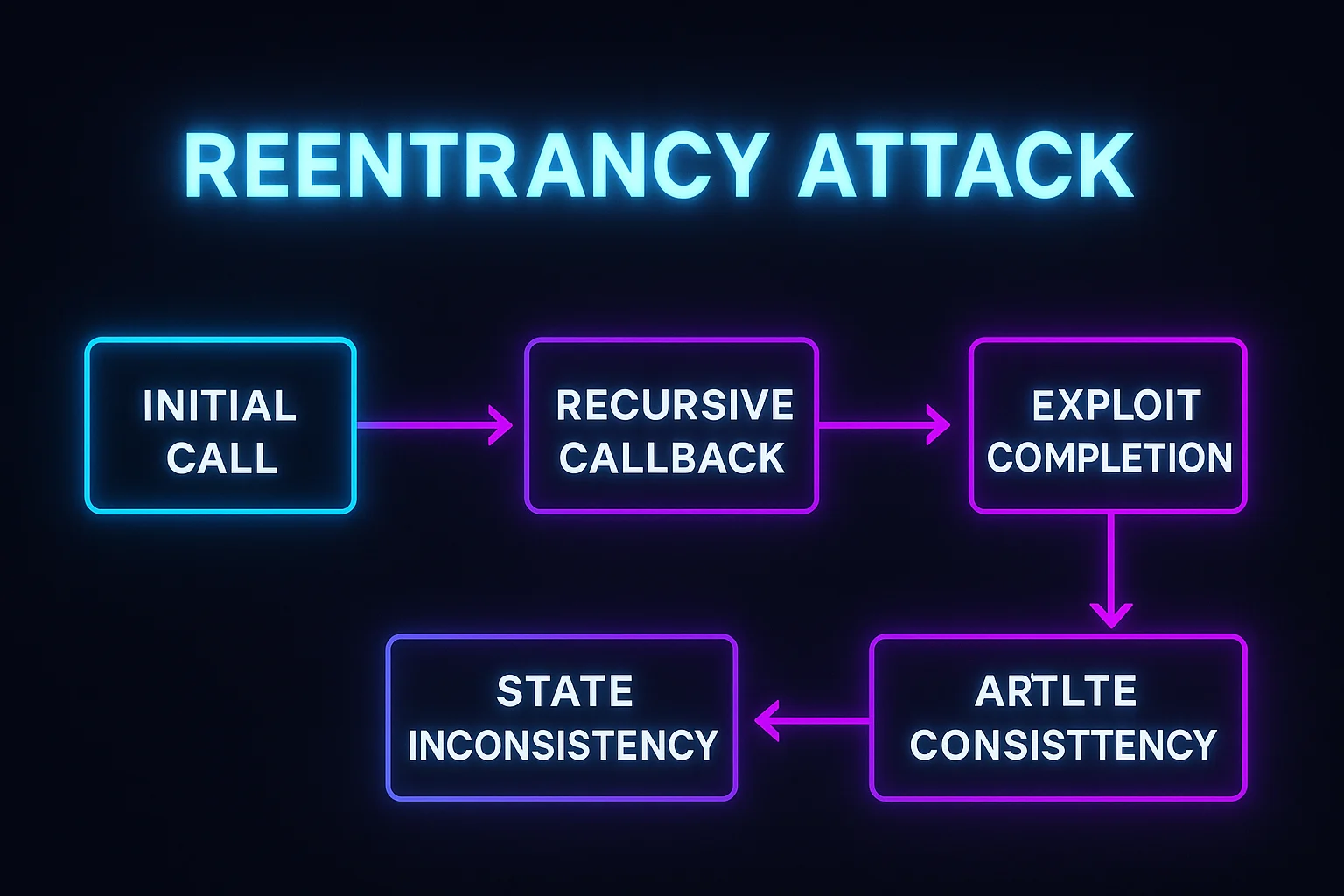
Reentrancy attack flow showing initial call, recursive callback, state inconsistency, and exploit completion

Real-World Examples

  • The DAO hack in 2016 used reentrancy to drain $60 million, leading to Ethereum’s hard fork
  • Various DeFi exploits have used reentrancy to steal millions from poorly secured protocols
  • Cream Finance lost $37 million to a reentrancy attack combined with other vulnerabilities

Why Beginners Should Care

Smart contract risk understanding helps evaluate protocol security and the importance of professional audits before using new platforms.

Prevention awareness shows why established protocols with battle-tested code tend to be safer than new, unaudited projects.

Recovery impossibility since blockchain transactions can’t be reversed, making prevention the only protection against reentrancy exploits.

Related Terms: Smart Contract, Smart Contract Audit, DeFi Security, Exploit

Back to Crypto Glossary

Similar Posts

  • Rollups

    Rollups: Scaling Through Bundling Rollups process hundreds of transactions off-chain then bundle the results into single on-chain transactions. It’s like carpooling for blockchain transactions – everyone shares the gas costs. Rollups are Layer 2 scaling solutions that execute transactions off the main blockchain but post transaction data on-chain for security. They inherit the security of…

  • Message Relay

    Message Relay: Cross-Chain Communication HubMessage relay systems transport data and instructions between different blockchain networks. They're like postal services for blockchain messages, ensuring information gets delivered across network boundaries.Message relay refers to infrastructure that enables communication between different blockchain networks by transporting data, transaction proofs, and execution instructions across chain boundaries. These systems enable cross-chain applications…

  • zk-STARKs

    zk-STARKs: Advanced Zero-Knowledge Proofszk-STARKs are cryptographic proofs that enable verification of computations without revealing underlying data, offering better scalability than earlier zero-knowledge technologies. They're like magic tricks where you can prove the trick worked perfectly without revealing how it was done, even to expert magicians.zk-STARKs (Zero-Knowledge Scalable Transparent Arguments of Knowledge) are advanced cryptographic proofs…

  • Market Cap

    Market Cap: How to Value Crypto Projects Market cap tells you how much the entire crypto market values a project. It’s the most important number for comparing different cryptocurrencies. Market capitalization is the total value of all coins in circulation, calculated by multiplying the current price by the circulating supply. It shows the relative size…

  • Appchain

    Appchain: Application-Specific Blockchains Appchains are blockchains designed for single applications or use cases rather than general-purpose smart contracts. They’re like having a dedicated highway for one type of vehicle instead of mixed traffic. An appchain is a blockchain optimized for a specific application or use case rather than supporting general-purpose smart contracts. This specialization enables…

  • WAGMI (We’re All Gonna Make It)

    WAGMI: Crypto’s Battle Cry WAGMI (We’re All Gonna Make It) is crypto’s rallying cry during tough times. It represents community solidarity and shared optimism about long-term success. WAGMI stands for “We’re All Gonna Make It” – a popular crypto community phrase expressing collective optimism about future success despite current market conditions. It originated from bodybuilding…