
Zero-Knowledge Proof (ZKP)

Zero-Knowledge Proof (ZKP): Proving Without Revealing

Zero-knowledge proofs let you prove you know something without revealing what you know. It’s like proving you’re over 21 without showing your birth date, address, or any other personal information.

A zero-knowledge proof (ZKP) is a cryptographic method that allows one party to prove they possess certain information without revealing the information itself. The verifier learns nothing except that the prover’s claim is true.

How Zero-Knowledge Proofs Work

Mathematical magic creates proofs that are computationally infeasible to fake but easy to verify. The prover demonstrates knowledge through complex calculations that would be impossible without the secret information.

Three properties define valid zero-knowledge proofs: completeness (honest provers can convince verifiers), soundness (dishonest provers cannot convince verifiers), and zero-knowledge (verifiers learn nothing beyond claim validity).

Practical applications include proving account balances without revealing amounts, demonstrating identity without sharing personal data, or validating transaction history without exposing details.
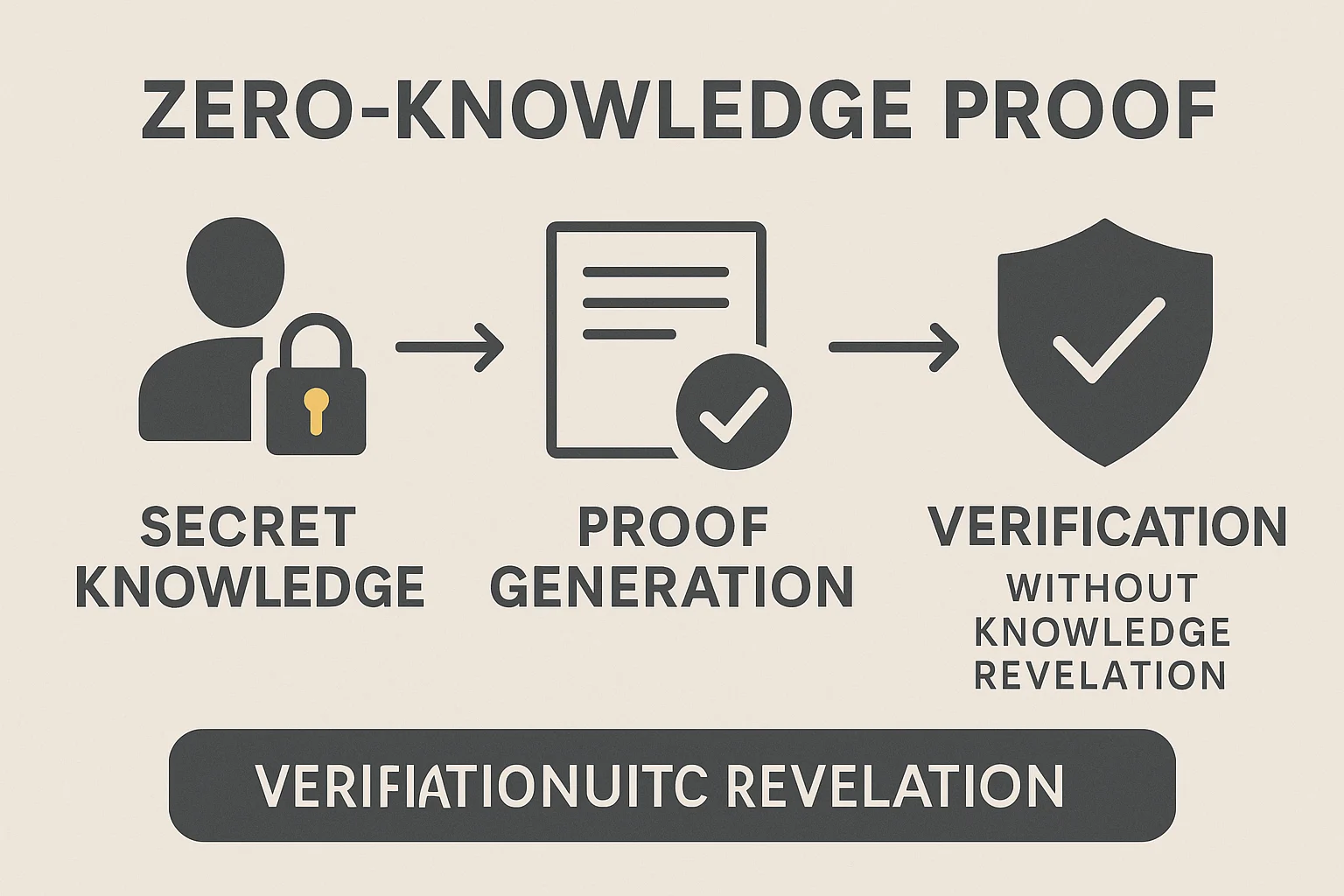
Infographic showing the zero-knowledge proof process: secret knowledge, proof generation, and verification without revealing the underlying data

Real-World Examples

  • Zcash transactions use zk-SNARKs to prove transaction validity without revealing amounts or addresses
  • Polygon Hermez uses zero-knowledge rollups for scalable Ethereum transactions
  • Age verification systems prove you’re over 18 without revealing your exact age or birthday

Why Beginners Should Care

Privacy revolution potential exists as ZKPs enable verification systems that don’t require sharing sensitive personal or financial information.

Scalability solutions like zk-rollups use zero-knowledge proofs to batch thousands of transactions while maintaining security and reducing costs.

Technical complexity makes ZKPs challenging to implement correctly, but user-facing applications hide this complexity behind simple interfaces.

Related Terms: Privacy Coin, zk-SNARKs, zk-STARKs, Rollups

Back to Crypto Glossary

Similar Posts

  • Impermanent Loss

    Impermanent Loss: The Hidden Cost of Liquidity Providing Impermanent loss is the sneaky tax on liquidity providers. Your tokens can lose value even when the pool is profitable. It’s math, not magic – but it feels like getting robbed. Impermanent loss occurs when the price ratio of tokens in a liquidity pool changes compared to…

  • Exit Scam

    Exit Scam: When Projects Disappear With Your Money Exit scams occur when project teams abandon their platforms after raising funds, taking investor money and disappearing. It’s the digital equivalent of skipping town with the cash register. An exit scam is when cryptocurrency project developers abandon their project after raising funds from investors, typically taking user…

  • Network Decentralization

    Network Decentralization: Distributed Control ArchitectureNetwork decentralization refers to distributing control and operation of blockchain networks across many independent participants rather than concentrating power. It's like having a town where decisions are made by all residents voting together instead of a single mayor controlling everything.Network decentralization describes the distribution of control, validation, and governance functions across…

  • Synthetic Asset

    Synthetic Asset: Creating Anything on Blockchain Synthetic assets are blockchain tokens that track the value of real-world assets like stocks, commodities, or currencies. They’re like financial derivatives but programmable and globally accessible. A synthetic asset is a tokenized derivative that tracks the price of an underlying asset without requiring direct ownership of that asset. Smart…

  • Rug Pull

    Rug Pull: When Projects Disappear With Your Money Rug pulls are crypto’s version of old-fashioned exit scams. Developers build hype, collect investor money, then vanish into the digital night. A rug pull is when cryptocurrency project developers abandon the project and steal investor funds. The term comes from “pulling the rug out” from under investors…

  • Cross-Chain Bridge

    Cross-Chain Bridge: Connecting Blockchain Islands Cross-chain bridges move assets between different blockchains, connecting isolated cryptocurrency ecosystems. They’re the highways between blockchain cities, but sometimes the bridges collapse. A cross-chain bridge is a protocol that enables the transfer of tokens, data, or smart contract calls between different blockchain networks. Bridges solve blockchain interoperability by creating connections…