
Flash Loan

Flash Loan: Borrowing Millions Without Collateral

Flash loans let you borrow millions of dollars without putting up collateral, but you must pay it back in the same transaction. It’s DeFi’s most mind-bending innovation.

A flash loan is an uncollateralized loan that must be borrowed and repaid within a single blockchain transaction. If you can’t repay the loan plus fees by the end of the transaction, the entire transaction reverts as if it never happened.

How Flash Loans Work

Smart contracts enforce the repayment requirement atomically. You can borrow millions, use the funds for arbitrage or other strategies, then repay the loan – all within one transaction that takes seconds.

Arbitrage opportunities are the most common use case. Traders borrow funds to exploit price differences between exchanges, keeping the profit after repaying the loan.

Liquidation of undercollateralized positions also uses flash loans, allowing liquidators to borrow funds to purchase discounted collateral from failing loans.
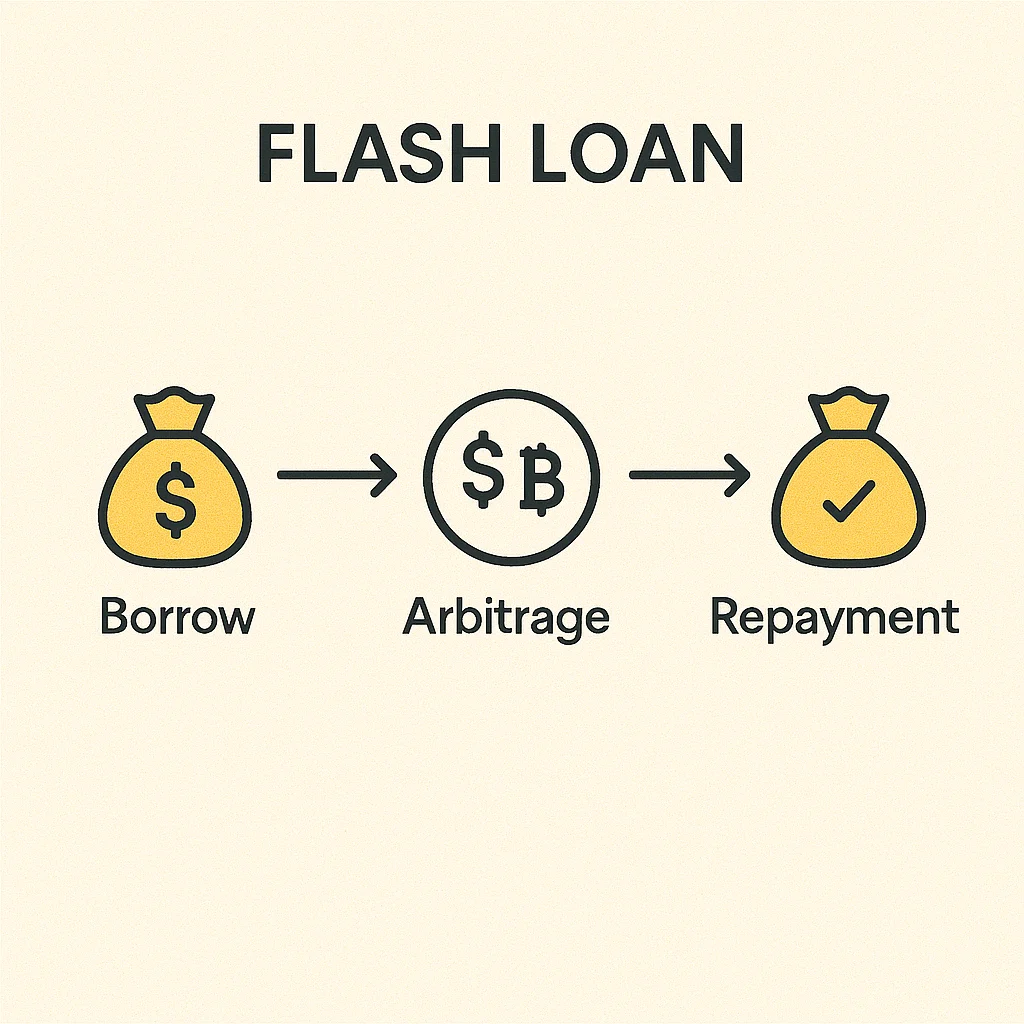
Infographic showing flash loan process with steps: borrow, arbitrage trade, and repayment—all within one atomic transaction

Real-World Examples

  • Aave pioneered flash loans and processes billions in flash loan volume monthly
  • Arbitrage bots use flash loans to exploit price differences across DEXs instantly
  • Complex DeFi strategies combine multiple protocols in single transactions using flash loan capital

Why Beginners Should Care

Flash loans democratize access to large amounts of capital for sophisticated trading strategies. You don’t need to be wealthy to execute million-dollar arbitrage trades.

However, flash loans require advanced programming knowledge and understanding of DeFi protocols. They’re also used in some exploit attacks against vulnerable smart contracts.

Learn the basics of DeFi and smart contracts before attempting flash loan strategies. The complexity makes it easy to lose money through coding errors or failed transaction logic.

Related Terms: Smart Contract, Arbitrage, Liquidation, DeFi

Back to Crypto Glossary

Similar Posts

  • Counterparty Risk

    Counterparty Risk: Trusting Others with Your MoneyCounterparty risk is the chance that the other party in a financial transaction won't fulfill their obligations. In crypto, it's the difference between self-custody and hoping someone else doesn't lose your money.Counterparty risk refers to the probability that the other party in a financial transaction will default on their…

  • Multichain Router

    Multichain Router: Cross-Chain Navigation Multichain routers find optimal paths for moving assets between different blockchain networks. They’re like GPS for cross-chain transactions, finding the cheapest and fastest routes. A multichain router is a protocol that automatically finds the best path for transferring assets between different blockchain networks. It compares routes across multiple bridges and chains…

  • Bot Trading

    Bot Trading: Automated Market ParticipationBot trading involves using automated software programs to execute cryptocurrency trades based on predetermined strategies and market conditions. It's like having a tireless assistant that trades for you around the clock.Bot trading refers to using automated software to execute cryptocurrency trades, monitor markets, and implement trading strategies without constant human supervision. These…

  • Full Node

    Full Node: Complete Blockchain ParticipantA full node maintains a complete copy of the blockchain and validates all transactions independently. It's like having the complete library instead of just borrowing books when you need them.A full node is a computer that downloads, stores, and validates the complete blockchain history while participating in network consensus and transaction…

  • Floor Price

    Floor Price: The Cheapest Entry Point Floor price is the lowest price you can buy into an NFT collection. It’s the most watched metric in NFT trading and often determines a project’s perceived value. Floor price is the lowest listed price for any NFT in a collection on marketplaces. It represents the minimum cost to…

  • SocialFi

    SocialFi: Social Media Meets Financial Incentives SocialFi combines social networking with decentralized finance, rewarding users for creating content and engaging with communities. It’s like getting paid to post, but with actual economic models behind it. SocialFi refers to social finance applications that integrate social media features with DeFi economics, enabling users to monetize social interactions…