
Block Reward

Block Reward: Miner and Validator Compensation

Block rewards are the cryptocurrency payments that miners and validators receive for successfully adding new blocks to the blockchain. It’s how networks incentivize security without charging transaction fees.

Block reward is the amount of cryptocurrency awarded to miners or validators for successfully creating and validating a new block on the blockchain. These rewards come from newly minted tokens and transaction fees included in the block.

How Block Rewards Work

New token creation through block rewards is often the primary way cryptocurrency enters circulation, following predetermined emission schedules rather than arbitrary printing.

Halving events reduce block rewards periodically to control inflation and maintain scarcity. Bitcoin halves rewards every 210,000 blocks, roughly every four years.

Fee supplements add transaction fees to base block rewards, creating variable compensation based on network usage and user willingness to pay for priority processing.
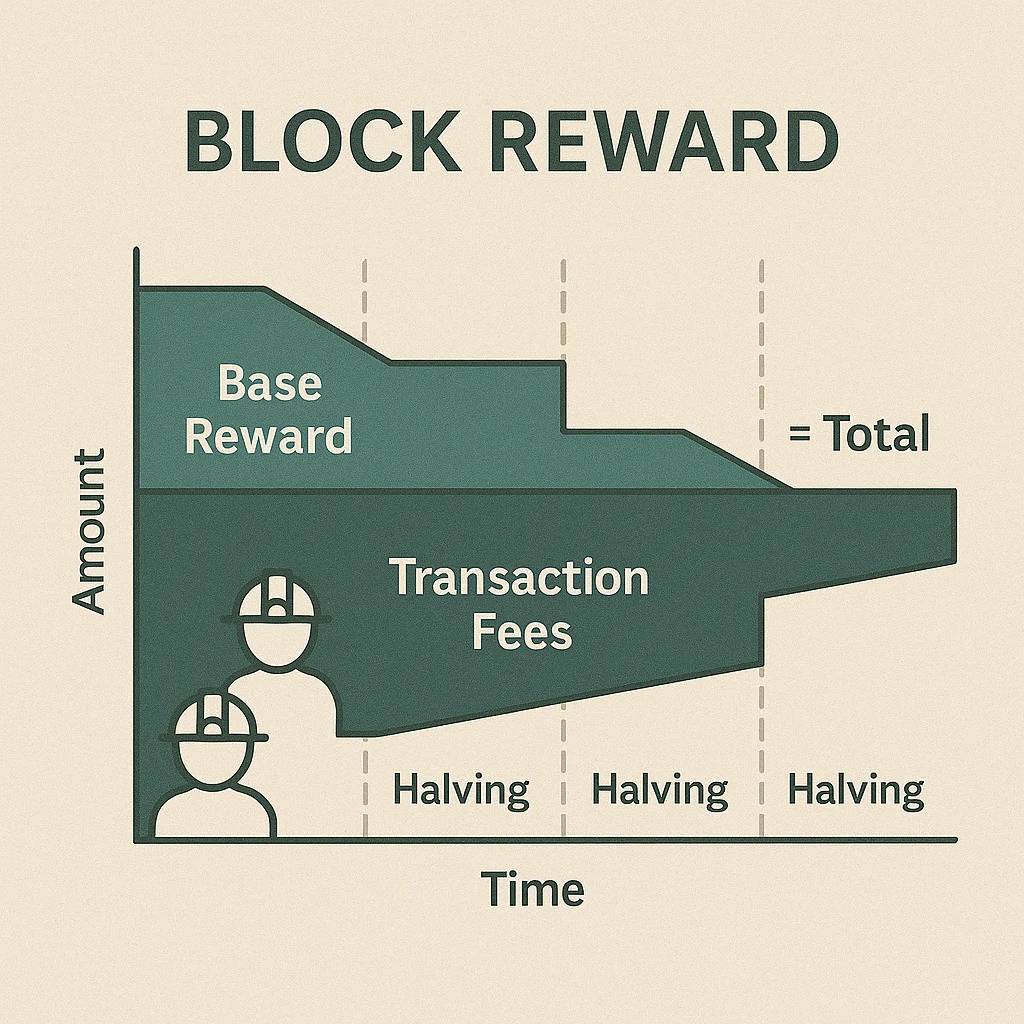
Infographic showing how block rewards are composed of a base reward plus transaction fees, with halving events over time

Real-World Examples

  • Bitcoin currently awards 6.25 BTC per block (next halving to 3.125 BTC expected in 2024)
  • Ethereum switched from mining rewards to staking rewards of ~6% annually
  • Litecoin follows Bitcoin’s model with 12.5 LTC rewards that halve periodically

Why Beginners Should Care

Supply inflation from block rewards affects token economics and long-term value. Higher inflation rates can pressure prices downward if adoption doesn’t keep pace.

Network security depends on adequate block rewards to incentivize miners or validators. Insufficient rewards can lead to reduced security and potential attacks.

Investment timing around halving events often affects price speculation as reduced supply inflation meets existing demand.

Related Terms: Mining, Halving, Staking Rewards, Token Economics

Back to Crypto Glossary

Similar Posts

  • Timelock

    Timelock: Time-Based Access ControlTimelock mechanisms prevent access to funds or functions until predetermined time conditions are met. It's like having a safe that only opens at specific times.A timelock is a smart contract feature that restricts access to funds, functions, or actions until a specified time period has elapsed. These mechanisms provide security through delayed execution…

  • Gasless Transactions

    Gasless Transactions: Fee-Free User Experience Gasless transactions eliminate the need for users to hold native tokens for transaction fees by having third parties sponsor the gas costs. It’s like having someone else pay for your Uber rides. Gasless transactions enable users to interact with blockchain applications without holding native tokens for gas fees. Third parties,…

  • Scaling

    Scaling: Handling More TransactionsScaling refers to increasing a blockchain network's capacity to handle more transactions per second without sacrificing security or decentralization. It's the holy grail of blockchain development.Scaling in blockchain technology involves improving transaction throughput, reducing costs, and maintaining performance as networks grow in size and usage. This typically requires technical solutions that balance speed,…

  • Web3

    Web3: The Decentralized Internet Dream Web3 promises an internet where users own their data, identity, and digital assets instead of tech giants controlling everything. It’s part vision, part reality, part marketing buzzword. Web3 refers to a decentralized version of the internet built on blockchain technology where users control their own data, identity, and assets rather…

  • Hash Function

    Hash Function: One-Way Mathematical TransformationHash functions are mathematical algorithms that convert input data into fixed-size output strings in a way that's easy to compute forward but practically impossible to reverse. They're like digital fingerprints for data.A hash function is a mathematical algorithm that takes input data of any size and produces a fixed-size output (hash)…

  • Token Incentives

    Token Incentives: Rewarding Desired BehaviorToken incentives use cryptocurrency rewards to encourage specific behaviors or participation in networks and protocols. They're like loyalty points that actually have real value and utility.Token incentives refer to mechanisms that distribute cryptocurrency tokens to users who perform desired actions or contribute value to networks and protocols. These align user behavior with…