
Privacy Coin

Privacy Coin: Digital Cash That Actually Hides

Privacy coins use advanced cryptography to hide transaction details like amounts, senders, and receivers. They’re what Bitcoin was supposed to be before everyone realized blockchain transactions are completely transparent.

Privacy coins are cryptocurrencies designed to provide anonymous or untraceable transactions through advanced cryptographic techniques. Unlike Bitcoin where all transactions are publicly visible, privacy coins obscure transaction details to protect user financial privacy.

How Privacy Coins Work

Ring signatures mix your transaction with others, making it impossible to determine which participant actually sent the funds. It’s like having multiple people sign a document with identical handwriting.

Stealth addresses generate unique one-time addresses for each transaction, preventing outside observers from linking multiple payments to the same recipient.

Zero-knowledge proofs verify transaction validity without revealing amounts, addresses, or other sensitive information to network validators or blockchain observers.
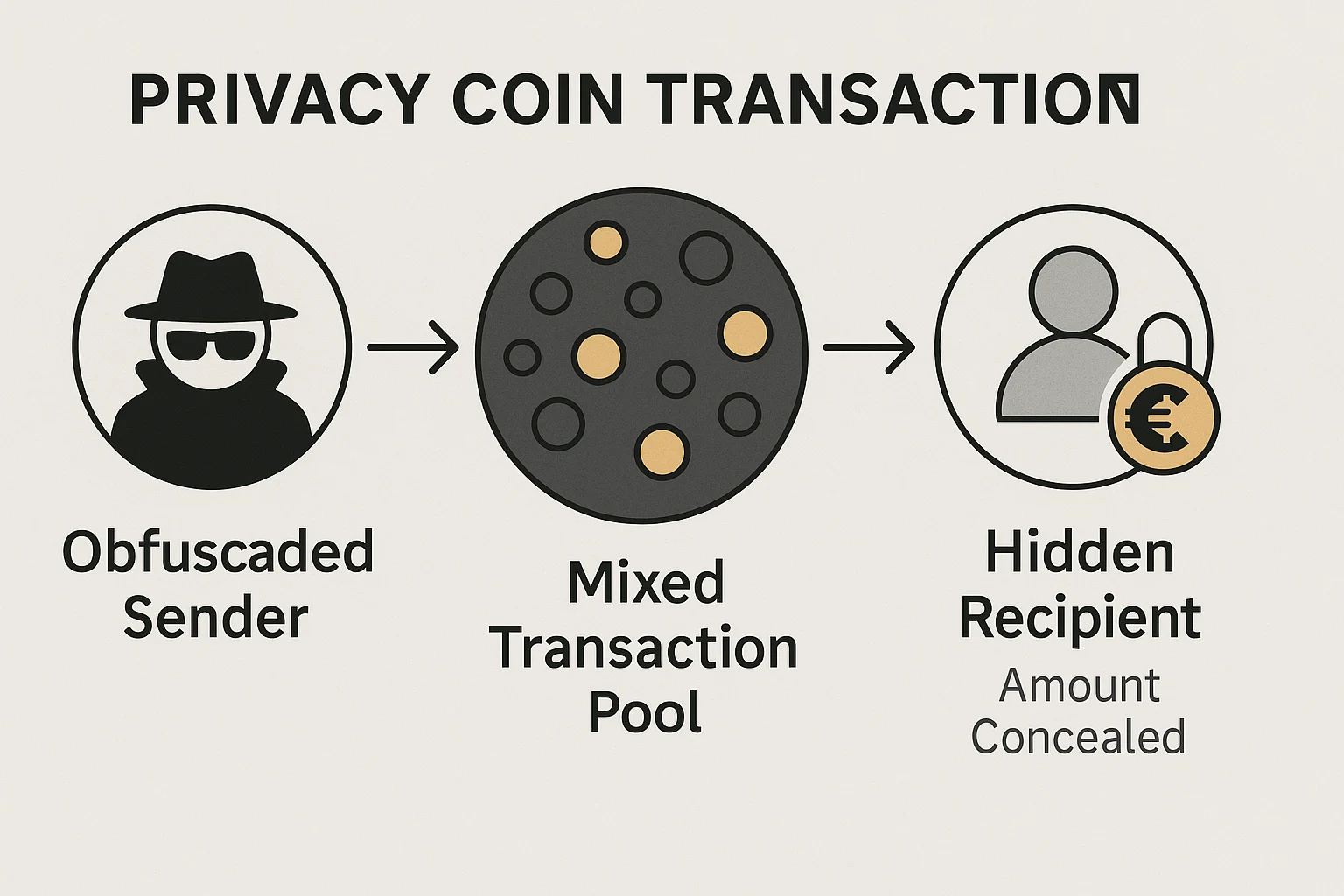
Infographic showing a privacy coin transaction flow with obfuscated sender, mixed transaction pool, and hidden recipient with concealed amount

Real-World Examples

  • Monero (XMR) – Uses ring signatures, stealth addresses, and RingCT for comprehensive privacy
  • Zcash (ZEC) – Offers optional privacy through zero-knowledge proofs called zk-SNARKs
  • Dash – Provides mixing services through CoinJoin-style transactions

Why Beginners Should Care

Financial privacy matters for legitimate reasons like preventing targeted theft, business confidentiality, and protection from authoritarian surveillance.

Regulatory pressure has forced many exchanges to delist privacy coins, limiting liquidity and adoption despite growing demand for financial privacy.

Enhanced security protects users from physical attacks since transaction histories can’t be used to identify wealthy targets for robbery or extortion.

Related Terms: Zero-Knowledge Proof, Ring Signatures, Stealth Address, Mixing Service

Back to Crypto Glossary

Similar Posts

  • Security Token

    Security Token: Regulated Digital AssetsSecurity tokens are cryptocurrency tokens that represent ownership in real-world assets and are subject to securities regulations. They're like digital stock certificates that comply with financial laws.Security tokens are cryptocurrency tokens that represent ownership stakes in real-world assets and are subject to securities regulations and compliance requirements. These bridge traditional finance with…

  • Validator

    Validator: Proof-of-Stake Network Guardians Validators are the security backbone of proof-of-stake networks. They propose blocks, verify transactions, and earn rewards for honest behavior. A validator is a network participant in proof-of-stake blockchains who validates transactions, proposes new blocks, and maintains network consensus in exchange for staking rewards. Validators replace miners in PoS systems. How Validators…

  • Liquidity Lock

    Liquidity Lock: Securing Trading LiquidityLiquidity lock prevents withdrawal of trading liquidity for specified time periods to ensure market stability and prevent rug pulls. It's like putting trading funds in a time-locked safe that can't be opened early.Liquidity lock refers to mechanisms that prevent withdrawal of liquidity provider tokens or trading pair liquidity for predetermined time…

  • Cross-Chain Bridge

    Cross-Chain Bridge: Connecting Blockchain Islands Cross-chain bridges move assets between different blockchains, connecting isolated cryptocurrency ecosystems. They’re the highways between blockchain cities, but sometimes the bridges collapse. A cross-chain bridge is a protocol that enables the transfer of tokens, data, or smart contract calls between different blockchain networks. Bridges solve blockchain interoperability by creating connections…

  • On-Chain Gaming

    On-Chain Gaming: Fully Decentralized Games On-chain gaming runs game logic entirely on blockchain networks rather than traditional servers. It’s like having board games where the rules are enforced by mathematics instead of human referees. On-chain gaming executes all game logic, state management, and interactions through smart contracts on blockchain networks. Unlike traditional games with centralized…

  • DEX Aggregator

    DEX Aggregator: Optimal Trading Route FinderDEX aggregators find the best prices across multiple decentralized exchanges for cryptocurrency trades. They're like price comparison websites that automatically execute trades at the best available rates.A DEX aggregator is a service that compares prices and liquidity across multiple decentralized exchanges to find optimal trading routes for cryptocurrency swaps. These platforms…