
Account Abstraction

Account Abstraction: Smart Contract Wallets

Account abstraction turns wallets into programmable smart contracts with custom logic for transaction validation. It’s like upgrading from a basic calculator to a full computer.

Account abstraction allows user accounts to be controlled by smart contract code rather than simple private key signatures. This enables programmable wallets with custom authentication, automatic payments, social recovery, and other advanced features impossible with traditional accounts.

How Account Abstraction Works

Custom validation logic replaces standard signature checks with programmable rules like multi-signature requirements, time-based restrictions, or biometric authentication.

Sponsored transactions enable third parties to pay gas fees for users, removing the need to hold native tokens for transaction costs.

Bundled operations combine multiple actions into single transactions, like approving and swapping tokens in one step rather than separate transactions.
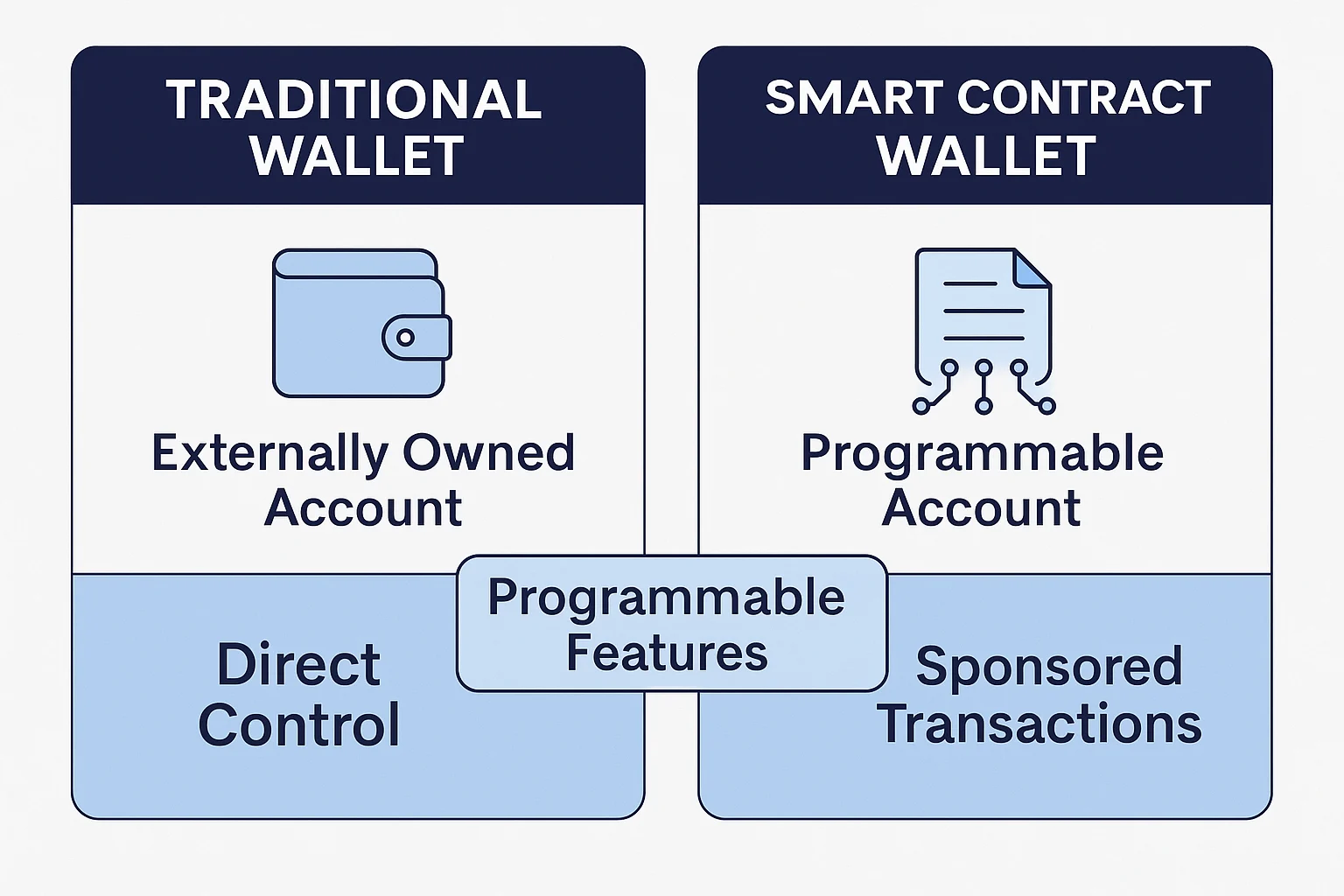
Account abstraction comparison showing traditional externally owned wallet vs smart contract wallet with programmable features and sponsored transactions.

Real-World Examples

  • Safe (formerly Gnosis Safe) provides multisig smart contract wallets with recovery features
  • Argent offers mobile wallets with social recovery and gasless transactions
  • EIP-4337 standardizes account abstraction implementation across Ethereum

Why Beginners Should Care

Better user experience eliminates many crypto UX pain points like gas fee management, seed phrase backup, and irreversible transaction mistakes.

Enhanced security through programmable rules like spending limits, trusted contacts for recovery, and automatic fraud detection that goes beyond simple private key protection.

Mass adoption potential as account abstraction makes crypto wallets behave more like traditional banking apps that mainstream users already understand.

Related Terms: Smart Contract, Multi-Signature, Social Recovery, Gas Fees

Back to Crypto Glossary

Similar Posts

  • Native Interop

    Native Interop: Built-in Cross-Chain CommunicationNative interoperability refers to blockchain networks designed from the ground up to communicate with other chains without requiring external bridges or intermediaries. It's like speaking multiple languages fluently.Native interoperability describes blockchain architectures that include cross-chain communication capabilities as core features rather than external additions. These systems can interact with other networks through…

  • Block Reward

    Block Reward: Miner and Validator Compensation Block rewards are the cryptocurrency payments that miners and validators receive for successfully adding new blocks to the blockchain. It’s how networks incentivize security without charging transaction fees. Block reward is the amount of cryptocurrency awarded to miners or validators for successfully creating and validating a new block on…

  • Restaking

    Restaking: Double-Duty for Staked Assets Restaking allows already-staked cryptocurrency to secure additional networks and earn extra rewards. It’s like getting paid twice for the same job, but with twice the risk. Restaking is a mechanism that allows staked cryptocurrency to simultaneously secure multiple networks or protocols, earning additional rewards beyond the base staking yield. Validators…

  • EIP-2612

    EIP-2612: Permit Function for Token ApprovalsEIP-2612 introduces permit functions that allow token approvals through signatures instead of transactions. It's like giving someone permission to spend your money without having to make a separate payment for the permission slip.EIP-2612 is an Ethereum Improvement Proposal that adds permit functionality to ERC-20 tokens, enabling approvals through off-chain signatures…

  • Time-Weighted Average Price (TWAP)

    Time-Weighted Average Price (TWAP): Manipulation-Resistant Pricing TWAP calculates asset prices over extended time periods to resist manipulation and provide more stable price references for protocols. It’s like taking your temperature every hour instead of just once. Time-Weighted Average Price (TWAP) is a pricing mechanism that calculates the average price of an asset over a specific…

  • Transaction Ordering

    Transaction Ordering: Sequence Control SystemsTransaction ordering determines the sequence in which transactions get processed within blockchain blocks. It's like controlling the line at a busy restaurant.Transaction ordering refers to the process by which blockchain networks determine the sequence of transactions within blocks. This ordering can significantly affect transaction outcomes, especially in DeFi applications sensitive to price…