
Liquidity Mining

Liquidity Mining: Earning Rewards for Providing Liquidity

Liquidity mining rewards users who provide capital to DeFi protocols with governance tokens. It’s like getting paid to be the house money at a casino.

Liquidity mining is a DeFi incentive mechanism where protocols distribute governance tokens to users who provide liquidity to their platforms. Users earn both trading fees and token rewards for supplying capital to liquidity pools.

How Liquidity Mining Works

Yield farming involves providing liquidity to automated market makers, lending protocols, or other DeFi applications in exchange for native token rewards.

Emission schedules control how many tokens get distributed and over what timeframe, often decreasing over time to prevent excessive inflation.

Staking rewards supplement trading fees with governance tokens, creating additional income streams for liquidity providers beyond fee sharing.
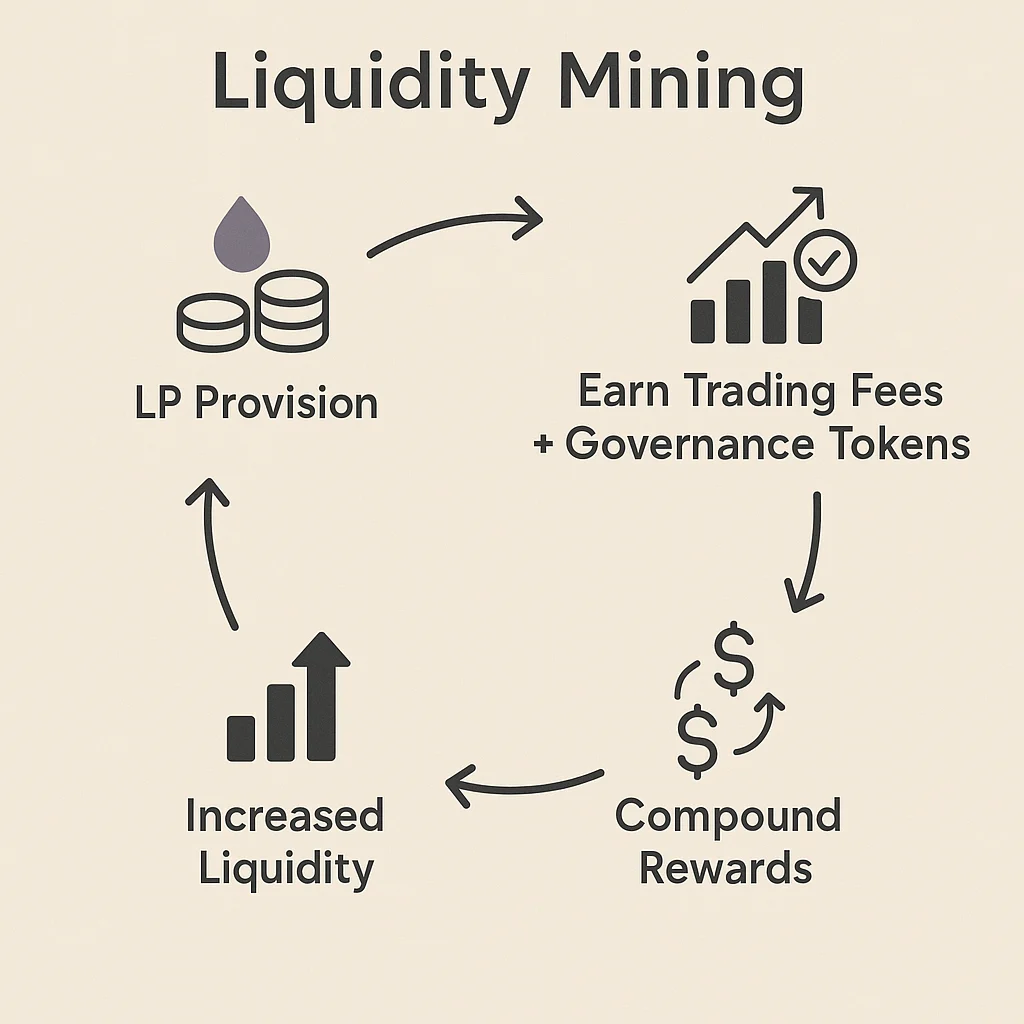
Infographic showing the liquidity mining cycle with steps: LP provision, earning trading fees and governance tokens, compounding rewards, and increasing liquidity

Real-World Examples

  • Uniswap’s UNI distribution rewarded early liquidity providers with governance tokens worth thousands
  • Compound’s COMP mining launched the DeFi summer of 2020 with lucrative token rewards
  • SushiSwap vampire attack used higher liquidity mining rewards to steal liquidity from Uniswap

Why Beginners Should Care

High yields during protocol launches can provide exceptional returns, but these often decrease rapidly as more users participate and token prices stabilize.

Token risk means liquidity mining rewards may become worthless if governance tokens lose value, potentially wiping out gains from fee earnings.

Impermanent loss still applies to liquidity mining positions, requiring careful analysis of whether token rewards compensate for potential price divergence losses.

Related Terms: Yield Farming, Liquidity Pool, Governance Token, Impermanent Loss

Back to Crypto Glossary

Similar Posts

  • Public Key

    Public Key: Your Crypto Receiving Address Your public key is like your email address for crypto – you can share it freely without security concerns. A public key is cryptographically derived from your private key and generates your wallet addresses where others can send you cryptocurrency. It’s mathematically linked to your private key but reveals…

  • Public Key

    Public Key: Cryptographic Identity VerificationA public key is the openly shareable part of a cryptographic key pair that enables others to send you cryptocurrency or verify your digital signatures. It's like your mailing address that you can give to anyone who wants to send you mail.Public key refers to the cryptographic component of a key…

  • Play-to-Earn (P2E)

    Play-to-Earn (P2E): Gaming Meets Income Play-to-earn games let players earn cryptocurrency and NFTs through gameplay. It’s turned gaming from entertainment expense into potential income source for millions worldwide. Play-to-earn (P2E) is a gaming model where players earn cryptocurrency tokens, NFTs, or other digital assets with real-world value through gameplay activities. Players own in-game assets that…

  • Sidechain

    Sidechain: Independent Chains with Main Chain Connections Sidechains operate independently while maintaining bridges to main blockchains. They’re like having a separate express lane that connects back to the main highway when needed. A sidechain is an independent blockchain that runs parallel to a main blockchain and is connected through a two-way bridge allowing asset transfers….

  • FUD (Fear, Uncertainty, Doubt)

    FUD: Fear, Uncertainty, and Doubt FUD is FOMO’s evil twin. While FOMO makes you buy at peaks, FUD makes you sell at bottoms. Understanding FUD helps you think clearly when markets panic. FUD stands for Fear, Uncertainty, and Doubt – negative sentiment spread to influence crypto prices downward. Sometimes it’s legitimate concerns, often it’s manufactured…

  • Payment Channel

    Payment Channel: Off-Chain Transaction RoutingPayment channels enable fast, cheap cryptocurrency transactions between parties without recording every transaction on the blockchain. They're like running a tab at a restaurant instead of paying for each item separately.A payment channel is an off-chain mechanism that allows two parties to conduct multiple cryptocurrency transactions without broadcasting each one to…