
Optimistic Rollup

Optimistic Rollup: Trust but Verify Scaling

Optimistic rollups assume transactions are valid by default but allow challenges during dispute periods. It’s like innocent until proven guilty for blockchain transactions.

An optimistic rollup is a Layer 2 scaling solution that assumes transactions are valid by default and only verifies them if someone submits a fraud proof during a challenge period. This enables fast, cheap transactions while maintaining security through economic incentives.

How Optimistic Rollups Work

Optimistic execution processes transactions immediately without validation, posting transaction data to the main chain for availability.

Challenge periods allow anyone to submit fraud proofs if they detect invalid transactions, with economic penalties for false challenges.

Fraud proofs enable verification of specific transactions without re-executing entire blocks, making dispute resolution efficient.
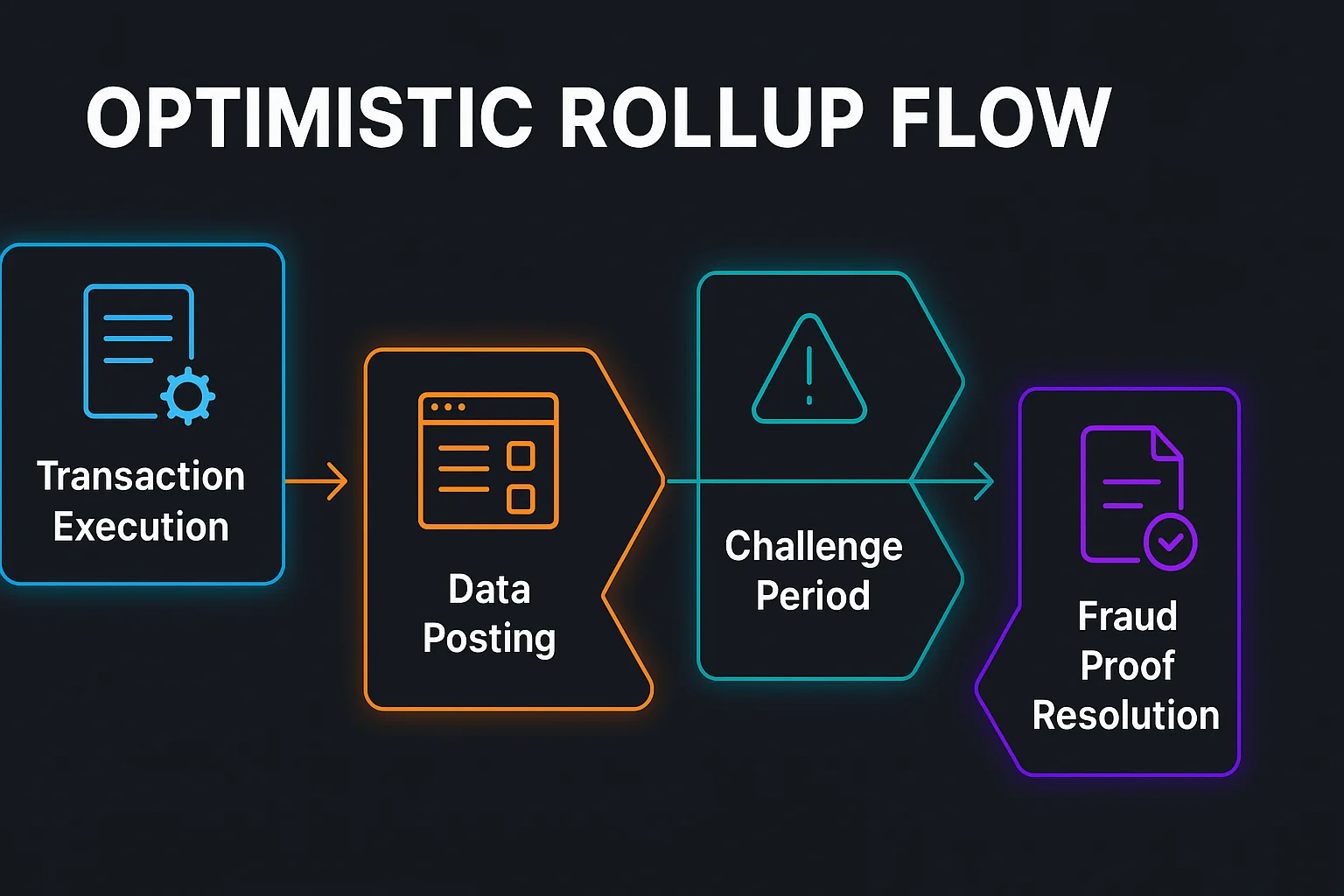
Optimistic rollup process showing transaction execution, data posting, challenge period, and fraud proof resolution

Real-World Examples

  • Arbitrum is the largest optimistic rollup with billions in TVL and major DeFi protocols
  • Optimism focuses on public goods funding and retroactive rewards for ecosystem development
  • Polygon Hermez (now zkEVM) started as an optimistic rollup before transitioning to ZK proofs

Why Beginners Should Care

Fast finality for most transactions since optimistic assumptions allow immediate execution without waiting for complex validation.

Withdrawal delays typically require 7-day challenge periods before funds can be moved back to Ethereum mainnet.

Lower costs compared to Ethereum mainnet while maintaining strong security guarantees through fraud proof mechanisms.

Related Terms: Layer 2, Fraud Proof, Challenge Period, Rollups

Back to Crypto Glossary

Similar Posts

  • Network Congestion

    Network Congestion: Blockchain Traffic JamsNetwork congestion occurs when cryptocurrency networks become overloaded with transaction requests, causing delays and increased fees. It's like rush hour traffic that slows everyone down and costs more to navigate.Network congestion refers to periods when cryptocurrency networks receive more transaction requests than they can process efficiently, resulting in delayed confirmations and…

  • AML (Anti-Money Laundering)

    AML (Anti-Money Laundering): Fighting Financial Crime AML regulations force crypto businesses to monitor and report suspicious activities. It’s the government’s attempt to prevent crypto from becoming a money laundering paradise. Anti-Money Laundering (AML) refers to laws, regulations, and procedures designed to prevent criminals from disguising illegally obtained funds as legitimate income. Crypto exchanges and businesses…

  • Cryptographic Proof

    Cryptographic Proof: Mathematical VerificationCryptographic proof provides mathematical certainty about the validity of information without revealing sensitive details. It's like proving you know a secret without actually telling anyone what the secret is.Cryptographic proof refers to mathematical techniques that verify the authenticity, integrity, or validity of information using cryptographic methods. These proofs enable trust and verification without…

  • Zero-Knowledge Proof (ZKP)

    Zero-Knowledge Proof (ZKP): Proving Without Revealing Zero-knowledge proofs let you prove you know something without revealing what you know. It’s like proving you’re over 21 without showing your birth date, address, or any other personal information. A zero-knowledge proof (ZKP) is a cryptographic method that allows one party to prove they possess certain information without…

  • Gas Token

    Gas Token: Optimizing Transaction Costs Gas tokens store cheap gas for later use when network fees are high. It’s like buying gasoline when prices are low and using it when prices spike. A gas token is a cryptocurrency designed to optimize transaction costs by storing cheap gas during low-demand periods for use when fees are…

  • Crypto Vesting Schedule

    Crypto Vesting Schedule: Gradual Token Release Vesting schedules control when team members, investors, or community members can access their allocated tokens. It’s like having a time-locked savings account that prevents dumping. A crypto vesting schedule defines when and how allocated tokens become available for use, typically spreading releases over months or years to prevent market…