
Proof of Humanity

Proof of Humanity: Verifying Human Uniqueness

Proof of Humanity creates registries of verified unique humans to prevent Sybil attacks in voting and distribution systems. It’s like having a bouncer who knows everyone isn’t wearing a disguise.

Proof of Humanity is a system for creating verifiable registries of unique human beings to prevent individuals from claiming multiple identities in democratic or distribution systems. It aims to enable “one person, one vote” in digital contexts.

How Proof of Humanity Works

Identity verification through video submissions, vouching systems, and social verification to establish that each registration represents a unique human being.

Continuous validation requires periodic renewal and community challenges to maintain registry accuracy and remove fake or duplicate entries.

Application integration enables other protocols to use humanity verification for fair voting, airdrops, or governance participation.
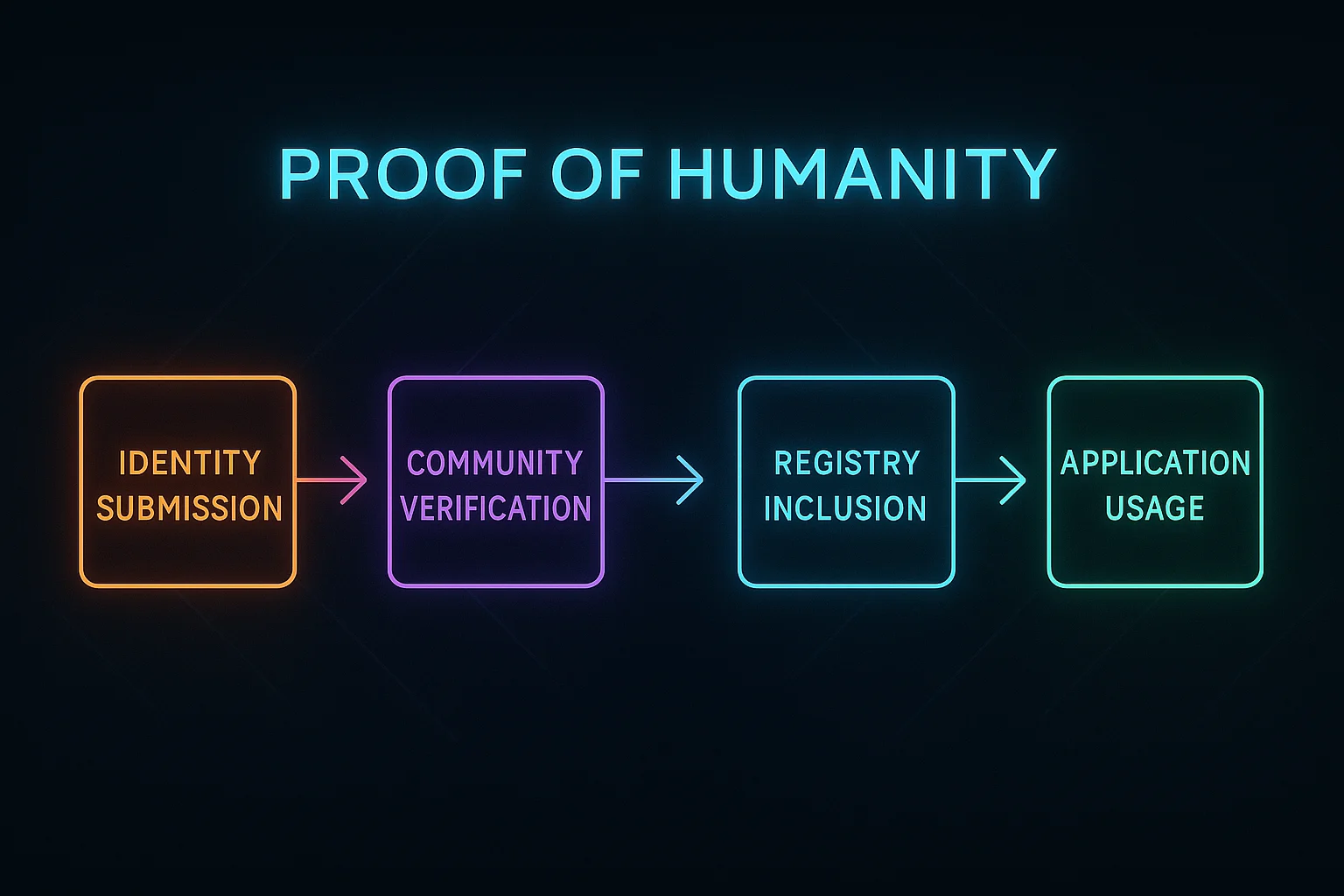
Proof of Humanity flow showing identity submission, community verification, registry inclusion, and application usage

Real-World Examples

  • Proof of Humanity protocol creates Ethereum-based registries of verified humans
  • Worldcoin uses biometric iris scanning for humanity verification
  • BrightID relies on social graph analysis to identify unique humans

Why Beginners Should Care

Democratic participation in crypto governance systems that need to prevent wealthy individuals from claiming multiple votes through fake identities.

Fair distribution mechanisms for airdrops and universal basic income programs that should reach real people rather than bot farms.

Privacy trade-offs as humanity verification often requires revealing personal information or biometric data to prove uniqueness.

Related Terms: Sybil Attack, Anti-Sybil Mechanism, Democratic Governance

Back to Crypto Glossary

Similar Posts

  • Cross-Chain Messaging

    Cross-Chain Messaging: Inter-Blockchain Communication Cross-chain messaging enables smart contracts on different blockchains to communicate and trigger actions across networks. It’s like having a universal translator for blockchain conversations. Cross-chain messaging allows smart contracts on different blockchain networks to send data, trigger functions, and coordinate actions across multiple chains. This enables true interoperability beyond simple asset…

  • Decentralized Identity (DID)

    Decentralized Identity (DID): Self-Sovereign Digital Identity DIDs give users control over their digital identity without relying on centralized authorities like governments or tech companies. It’s like having a passport that you issue and control yourself. Decentralized Identity (DID) is a digital identity framework that gives individuals control over their personal data and identity verification without…

  • Tornado Cash

    Tornado Cash: The Controversial Privacy Protocol Tornado Cash was Ethereum’s most popular mixing service until U.S. sanctions shut it down. It used zero-knowledge proofs to enable private transactions on a transparent blockchain. Tornado Cash was a decentralized mixing protocol on Ethereum that used zero-knowledge proofs to enable private transactions by breaking the link between sender…

  • On-Chain Gaming

    On-Chain Gaming: Fully Decentralized Games On-chain gaming runs game logic entirely on blockchain networks rather than traditional servers. It’s like having board games where the rules are enforced by mathematics instead of human referees. On-chain gaming executes all game logic, state management, and interactions through smart contracts on blockchain networks. Unlike traditional games with centralized…

  • HTLC

    HTLC: Hash Time-Locked ContractsHTLCs are smart contracts that lock cryptocurrency until specific conditions are met within time limits. They're like escrow services with built-in deadlines that automatically return funds if deals fall through.Hash Time-Locked Contracts (HTLCs) are smart contracts that require both cryptographic proof and time-based conditions to be met before cryptocurrency can be accessed. These…

  • Public Key

    Public Key: Cryptographic Identity VerificationA public key is the openly shareable part of a cryptographic key pair that enables others to send you cryptocurrency or verify your digital signatures. It's like your mailing address that you can give to anyone who wants to send you mail.Public key refers to the cryptographic component of a key…