
Total Value Locked (TVL)

Total Value Locked (TVL): DeFi’s Scorecard

TVL measures how much money is deposited in DeFi protocols. It’s like measuring the size of a bank by its total deposits – bigger usually means more trust and activity.

Total Value Locked (TVL) is the aggregate value of all assets deposited in a DeFi protocol or across the entire DeFi ecosystem. It represents how much capital users have entrusted to smart contracts for lending, trading, or yield farming.

How TVL Works

Asset valuation uses current market prices to calculate the dollar value of all deposited tokens. A protocol holding 1000 ETH at $2000 per ETH has $2 million TVL.

Double counting can inflate numbers when protocols build on each other. If Protocol A deposits funds into Protocol B, both might count the same assets toward their TVL.

TVL growth indicates increasing user confidence and adoption. Protocols with growing TVL typically offer competitive yields or innovative features attracting more deposits.
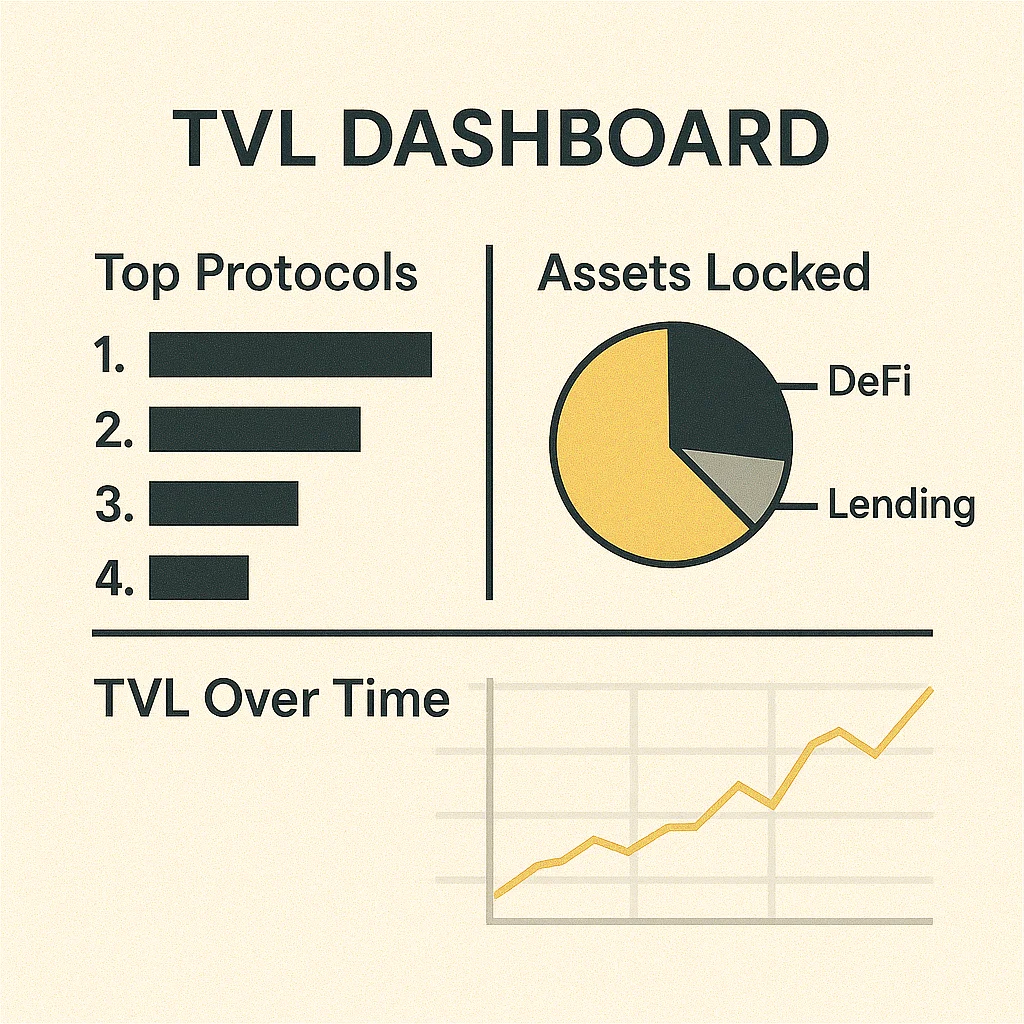
Infographic dashboard showing TVL rankings by protocol, asset categories (DeFi, Lending), and a historical growth line chart

Real-World Examples

  • Aave – Leading lending protocol with $10+ billion TVL across multiple chains
  • Uniswap – Largest DEX with $4+ billion in liquidity pools
  • Total DeFi TVL peaked at $180+ billion in 2021, currently around $50 billion

Why Beginners Should Care

TVL indicates protocol maturity and user trust. Protocols with higher TVL have more battle-tested smart contracts and established user bases.

Yield dilution often accompanies TVL growth. Early adopters earn higher yields that decrease as more users deposit funds and compete for the same rewards.

TVL crashes during bear markets or protocol exploits can signal fundamental problems or broader market stress affecting the entire DeFi ecosystem.

Related Terms: DeFi, Liquidity Pool, Yield Farming, Smart Contract

Back to Crypto Glossary

Similar Posts

  • Leverage

    Leverage: Borrowing Money to Amplify TradesLeverage lets you control larger positions than your actual capital by borrowing funds from exchanges or platforms. It's like using a lever to lift heavy objects – small movements create big effects.Leverage in cryptocurrency trading allows borrowing funds to increase position sizes beyond available capital, amplifying both potential profits and…

  • Blockchain

    Blockchain: The Unchangeable Digital Ledger Forget the hype – blockchain is simply a better way to keep records. It’s like a ledger book that everyone can see, but no one can cheat. Blockchain is a chain of digital records (blocks) that are linked together and secured using cryptography. Once information goes into a block, changing…

  • |

    Bridgeless Interop

    Bridgeless Interop: Direct Cross-Chain Communication Bridgeless interoperability enables direct communication between blockchains without traditional bridge infrastructure. It’s like having chains that can talk directly to each other instead of using translators. Bridgeless interoperability refers to cross-chain communication methods that don’t rely on traditional bridge protocols, instead using native blockchain features or specialized infrastructure for direct…

  • Two-Factor Authentication (2FA)

    Two-Factor Authentication (2FA): Your Crypto’s Second Lock 2FA is the minimum security standard for any crypto account worth protecting. If you’re not using it, you’re basically leaving your front door unlocked. Two-factor authentication (2FA) requires two different verification methods to access your account – typically something you know (password) plus something you have (phone or…

  • Smart Contract Compatibility

    Smart Contract Compatibility: Cross-Platform Code ExecutionSmart contract compatibility enables applications to run across different blockchain networks without modification. It's like writing software that works on both Windows and Mac without changes.Smart contract compatibility refers to the ability of smart contract code to execute on multiple blockchain platforms without requiring rewrites or significant modifications. This enables broader…

  • Protocol Revenue

    Protocol Revenue: Earning from Network ActivityProtocol revenue refers to income generated by blockchain protocols through transaction fees, service charges, or other value capture mechanisms. It's like toll roads that collect fees from everyone who uses the infrastructure.Protocol revenue encompasses all income streams generated by blockchain protocols including transaction fees, service charges, governance fees, and other…