
Block Reward

Block Reward: Miner and Validator Compensation

Block rewards are the cryptocurrency payments that miners and validators receive for successfully adding new blocks to the blockchain. It’s how networks incentivize security without charging transaction fees.

Block reward is the amount of cryptocurrency awarded to miners or validators for successfully creating and validating a new block on the blockchain. These rewards come from newly minted tokens and transaction fees included in the block.

How Block Rewards Work

New token creation through block rewards is often the primary way cryptocurrency enters circulation, following predetermined emission schedules rather than arbitrary printing.

Halving events reduce block rewards periodically to control inflation and maintain scarcity. Bitcoin halves rewards every 210,000 blocks, roughly every four years.

Fee supplements add transaction fees to base block rewards, creating variable compensation based on network usage and user willingness to pay for priority processing.
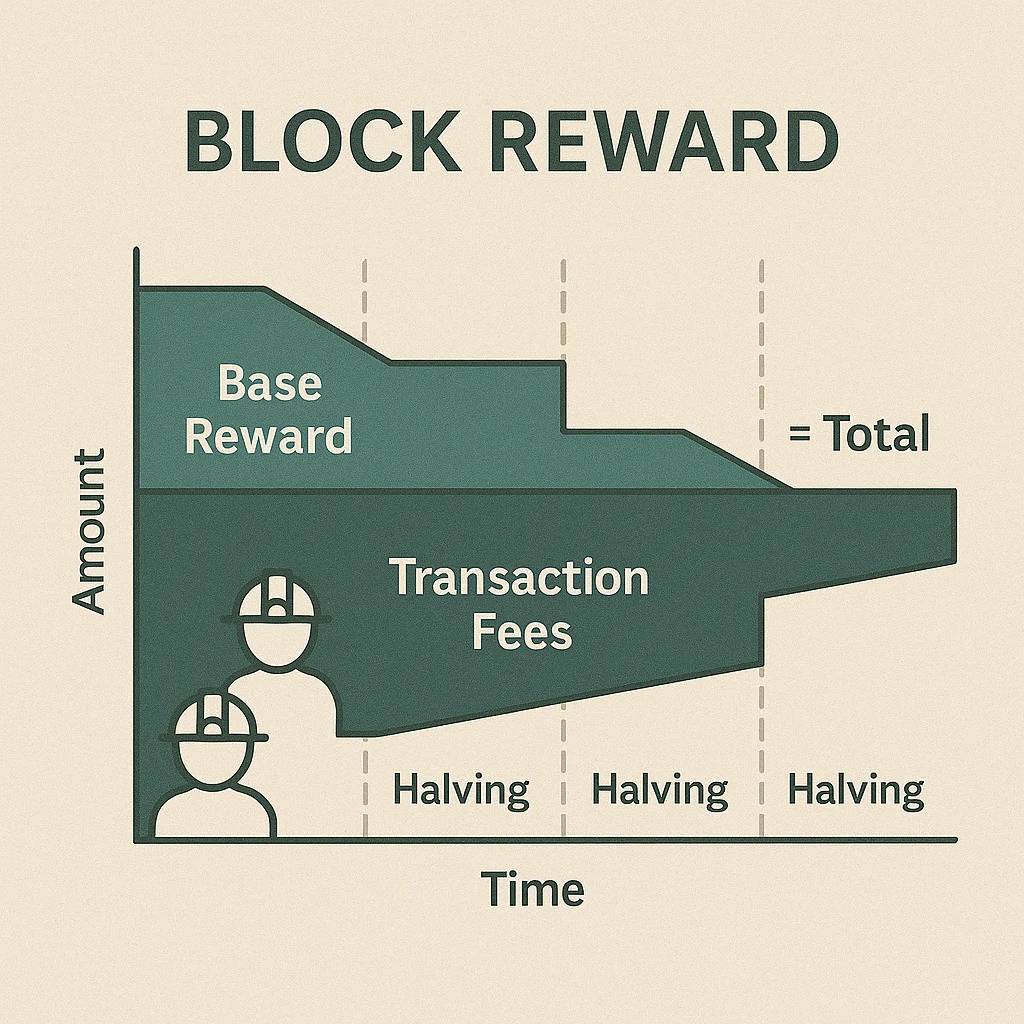
Infographic showing how block rewards are composed of a base reward plus transaction fees, with halving events over time

Real-World Examples

  • Bitcoin currently awards 6.25 BTC per block (next halving to 3.125 BTC expected in 2024)
  • Ethereum switched from mining rewards to staking rewards of ~6% annually
  • Litecoin follows Bitcoin’s model with 12.5 LTC rewards that halve periodically

Why Beginners Should Care

Supply inflation from block rewards affects token economics and long-term value. Higher inflation rates can pressure prices downward if adoption doesn’t keep pace.

Network security depends on adequate block rewards to incentivize miners or validators. Insufficient rewards can lead to reduced security and potential attacks.

Investment timing around halving events often affects price speculation as reduced supply inflation meets existing demand.

Related Terms: Mining, Halving, Staking Rewards, Token Economics

Back to Crypto Glossary

Similar Posts

  • Verifiable Credentials

    Verifiable Credentials: Tamper-Proof Digital DocumentsVerifiable credentials are digital documents that can be cryptographically verified without contacting the issuing authority. They're like diplomas that anyone can authenticate instantly.Verifiable credentials are digital documents that use cryptographic techniques to enable instant verification of authenticity without requiring contact with the issuing organization. These credentials enable trusted digital identity and qualification…

  • Protocol Revenue

    Protocol Revenue: Earning from Network ActivityProtocol revenue refers to income generated by blockchain protocols through transaction fees, service charges, or other value capture mechanisms. It's like toll roads that collect fees from everyone who uses the infrastructure.Protocol revenue encompasses all income streams generated by blockchain protocols including transaction fees, service charges, governance fees, and other…

  • Restaking

    Restaking: Double-Duty for Staked Assets Restaking allows already-staked cryptocurrency to secure additional networks and earn extra rewards. It’s like getting paid twice for the same job, but with twice the risk. Restaking is a mechanism that allows staked cryptocurrency to simultaneously secure multiple networks or protocols, earning additional rewards beyond the base staking yield. Validators…

  • Wei

    Wei: Ethereum's Smallest UnitWei is the smallest denomination of Ethereum, similar to how cents are the smallest unit of dollars. It's like measuring distances in millimeters when you need precision, even though we usually think in meters or kilometers.Wei represents the smallest possible unit of Ethereum (ETH), with one ETH equal to 1,000,000,000,000,000,000 (10^18) wei. This…

  • Private Key

    Private Key: Your Crypto’s Secret Password Your private key is the most important thing you’ll ever own in crypto. Lose it, and your money’s gone forever. No customer service number to call. A private key is a secret code that proves you own your cryptocurrency and allows you to spend it. It’s like the combination…

  • Encrypted Mempool

    Encrypted Mempool: Private Transaction Pools Encrypted mempools hide transaction details until inclusion in blocks, preventing front-running and MEV extraction. It’s like sending sealed bids instead of announcing your strategy publicly. An encrypted mempool contains pending transactions that are cryptographically hidden from public view until block inclusion. This prevents sophisticated actors from front-running or extracting MEV…