
Flash Loan

Flash Loan: Borrowing Millions Without Collateral

Flash loans let you borrow millions of dollars without putting up collateral, but you must pay it back in the same transaction. It’s DeFi’s most mind-bending innovation.

A flash loan is an uncollateralized loan that must be borrowed and repaid within a single blockchain transaction. If you can’t repay the loan plus fees by the end of the transaction, the entire transaction reverts as if it never happened.

How Flash Loans Work

Smart contracts enforce the repayment requirement atomically. You can borrow millions, use the funds for arbitrage or other strategies, then repay the loan – all within one transaction that takes seconds.

Arbitrage opportunities are the most common use case. Traders borrow funds to exploit price differences between exchanges, keeping the profit after repaying the loan.

Liquidation of undercollateralized positions also uses flash loans, allowing liquidators to borrow funds to purchase discounted collateral from failing loans.
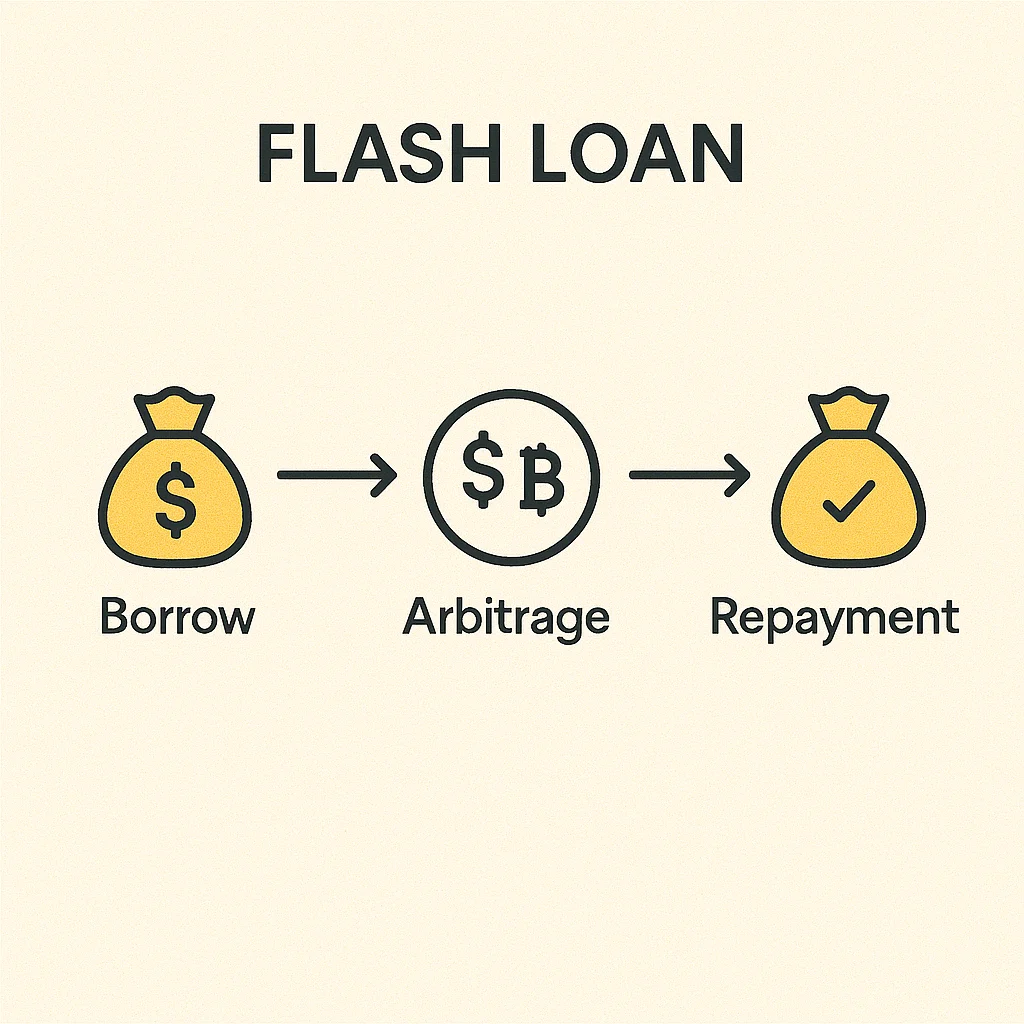
Infographic showing flash loan process with steps: borrow, arbitrage trade, and repayment—all within one atomic transaction

Real-World Examples

  • Aave pioneered flash loans and processes billions in flash loan volume monthly
  • Arbitrage bots use flash loans to exploit price differences across DEXs instantly
  • Complex DeFi strategies combine multiple protocols in single transactions using flash loan capital

Why Beginners Should Care

Flash loans democratize access to large amounts of capital for sophisticated trading strategies. You don’t need to be wealthy to execute million-dollar arbitrage trades.

However, flash loans require advanced programming knowledge and understanding of DeFi protocols. They’re also used in some exploit attacks against vulnerable smart contracts.

Learn the basics of DeFi and smart contracts before attempting flash loan strategies. The complexity makes it easy to lose money through coding errors or failed transaction logic.

Related Terms: Smart Contract, Arbitrage, Liquidation, DeFi

Back to Crypto Glossary

Similar Posts

  • Social Engineering

    Social Engineering: Manipulating People for AccessSocial engineering involves manipulating people psychologically to reveal sensitive information or perform actions that compromise security. It's hacking humans instead of computers.Social engineering refers to psychological manipulation techniques used to trick people into revealing confidential information, performing actions, or making security mistakes that benefit attackers. These attacks exploit human psychology rather…

  • Anti-Sybil Mechanism

    Anti-Sybil Mechanism: Preventing Fake Identity Attacks Anti-Sybil mechanisms prevent individuals from creating multiple fake identities to gain unfair advantages in voting, airdrops, or governance systems. They’re like requiring photo ID to prevent ballot stuffing. Anti-Sybil mechanisms are systems designed to prevent or detect when single entities create multiple fake identities to manipulate voting, governance, or…

  • Cold Storage

    Cold Storage: Maximum Security for Crypto Assets Cold storage keeps cryptocurrency private keys completely offline, away from any internet connection. It’s the digital equivalent of storing gold bars in a bank vault rather than your wallet. Cold storage refers to keeping cryptocurrency private keys on devices or media that have never been connected to the…

  • Decentralized Computing

    Decentralized Computing: Distributed Processing PowerDecentralized computing distributes computational tasks across networks of independent computers rather than relying on centralized data centers. It's like having a supercomputer made of everyone's spare processing power.Decentralized computing refers to distributed systems where computational tasks are processed across multiple independent nodes rather than centralized servers or data centers. This creates more…

  • Fee Market

    Fee Market: Transaction Cost EconomicsA fee market determines transaction costs through supply and demand dynamics between users and network capacity. It's like surge pricing for blockchain transactions during busy periods.A fee market is an economic system where transaction fees are determined by competition between users for limited blockchain processing capacity. Higher demand relative to supply drives…

  • Stable Yield

    Stable Yield: Predictable DeFi Returns Stable yield refers to DeFi strategies that provide consistent returns with lower volatility than traditional yield farming. It’s like finding the boring but reliable investment in a casino full of slot machines. Stable yield strategies focus on generating consistent returns from DeFi protocols with lower risk and volatility than high-APY…