
Total Value Locked (TVL)

Total Value Locked (TVL): DeFi’s Scorecard

TVL measures how much money is deposited in DeFi protocols. It’s like measuring the size of a bank by its total deposits – bigger usually means more trust and activity.

Total Value Locked (TVL) is the aggregate value of all assets deposited in a DeFi protocol or across the entire DeFi ecosystem. It represents how much capital users have entrusted to smart contracts for lending, trading, or yield farming.

How TVL Works

Asset valuation uses current market prices to calculate the dollar value of all deposited tokens. A protocol holding 1000 ETH at $2000 per ETH has $2 million TVL.

Double counting can inflate numbers when protocols build on each other. If Protocol A deposits funds into Protocol B, both might count the same assets toward their TVL.

TVL growth indicates increasing user confidence and adoption. Protocols with growing TVL typically offer competitive yields or innovative features attracting more deposits.
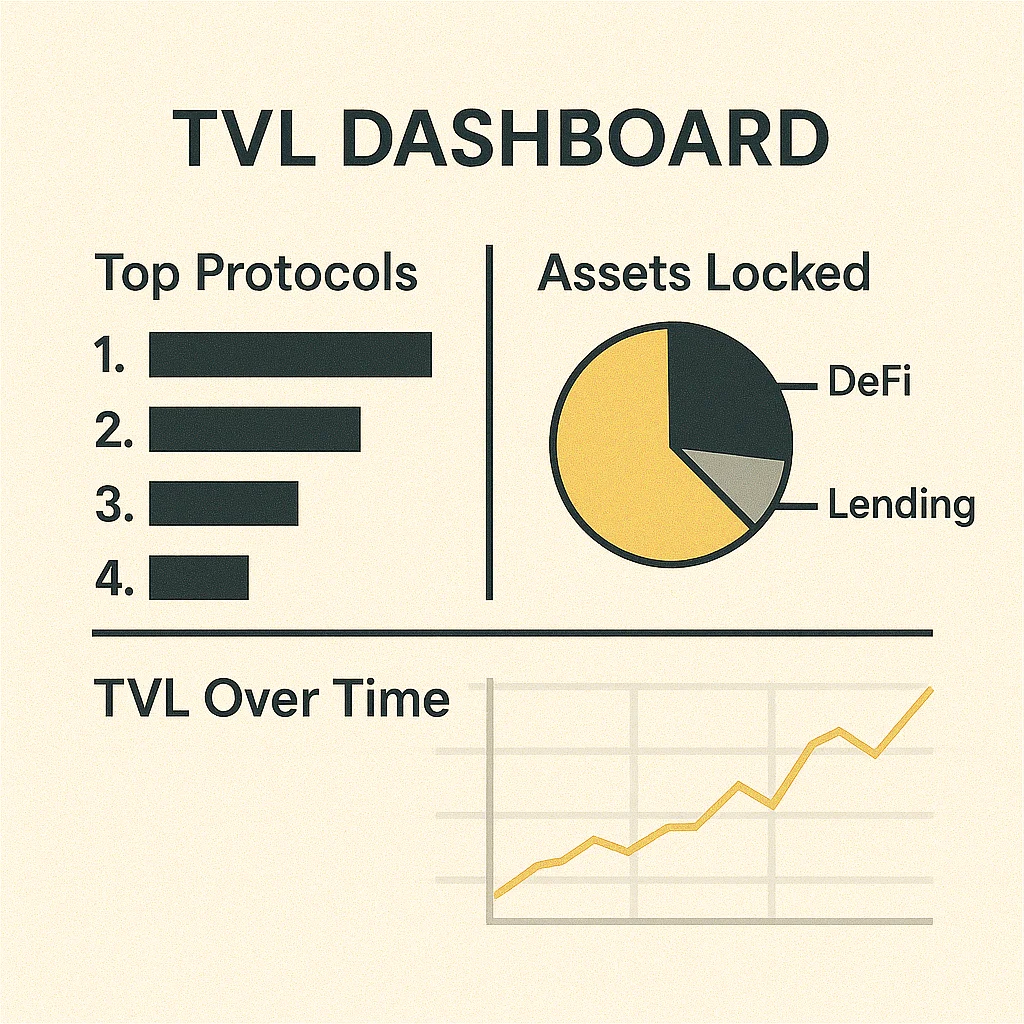
Infographic dashboard showing TVL rankings by protocol, asset categories (DeFi, Lending), and a historical growth line chart

Real-World Examples

  • Aave – Leading lending protocol with $10+ billion TVL across multiple chains
  • Uniswap – Largest DEX with $4+ billion in liquidity pools
  • Total DeFi TVL peaked at $180+ billion in 2021, currently around $50 billion

Why Beginners Should Care

TVL indicates protocol maturity and user trust. Protocols with higher TVL have more battle-tested smart contracts and established user bases.

Yield dilution often accompanies TVL growth. Early adopters earn higher yields that decrease as more users deposit funds and compete for the same rewards.

TVL crashes during bear markets or protocol exploits can signal fundamental problems or broader market stress affecting the entire DeFi ecosystem.

Related Terms: DeFi, Liquidity Pool, Yield Farming, Smart Contract

Back to Crypto Glossary

Similar Posts

  • Dynamic Gas Pricing

    Dynamic Gas Pricing: Adaptive Fee Markets Dynamic gas pricing automatically adjusts transaction fees based on network demand. It’s like surge pricing for blockchain transactions – pay more when everyone wants to transact. Dynamic gas pricing is a mechanism that automatically adjusts transaction fees based on current network congestion and demand. This creates more efficient fee…

  • Autonomous World (AW)

    Autonomous World (AW): Persistent Virtual Realities Autonomous worlds are persistent virtual environments that continue existing and evolving even when no players are actively participating. They’re like having a Minecraft world that keeps running and changing forever. An Autonomous World (AW) is a virtual environment that operates independently through blockchain infrastructure, maintaining state and enabling interactions…

  • Conservative Investing

    Conservative Investing: Low-Risk Investment ApproachConservative investing prioritizes capital preservation and steady returns over high-risk, high-reward strategies. It's like choosing the scenic route that takes longer but is much safer than the dangerous mountain pass.Conservative investing refers to investment strategies that prioritize capital preservation and risk reduction over maximum returns, typically focusing on established assets and…

  • AI Coins

    AI Coins: Cryptocurrency Meets Artificial Intelligence AI coins are cryptocurrencies focused on artificial intelligence applications, data marketplaces, or computational resources for machine learning. They’re betting that AI and crypto will merge into something bigger than both. AI coins are cryptocurrencies that facilitate artificial intelligence development, deployment, or monetization through decentralized networks. These tokens enable AI…

  • Over-Collateralization

    Over-Collateralization: Excess Security DepositsOver-collateralization requires borrowers to deposit assets worth more than their loan amount as security against default. It's like putting down a $15,000 deposit to borrow $10,000, ensuring the lender is protected even if asset values decline.Over-collateralization refers to requiring collateral deposits that exceed the value of loans or borrowed assets, providing additional…

  • Smart Contract Audit

    Smart Contract Audit: Code Security ReviewSmart contract audits involve professional security reviews of blockchain code to identify vulnerabilities before deployment. It's like having building inspectors for digital architecture.A smart contract audit is a comprehensive security review of blockchain application code conducted by experts to identify vulnerabilities, bugs, and potential attack vectors before public deployment. These reviews…