
Zero-Knowledge Proof (ZKP)

Zero-Knowledge Proof (ZKP): Proving Without Revealing

Zero-knowledge proofs let you prove you know something without revealing what you know. It’s like proving you’re over 21 without showing your birth date, address, or any other personal information.

A zero-knowledge proof (ZKP) is a cryptographic method that allows one party to prove they possess certain information without revealing the information itself. The verifier learns nothing except that the prover’s claim is true.

How Zero-Knowledge Proofs Work

Mathematical magic creates proofs that are computationally infeasible to fake but easy to verify. The prover demonstrates knowledge through complex calculations that would be impossible without the secret information.

Three properties define valid zero-knowledge proofs: completeness (honest provers can convince verifiers), soundness (dishonest provers cannot convince verifiers), and zero-knowledge (verifiers learn nothing beyond claim validity).

Practical applications include proving account balances without revealing amounts, demonstrating identity without sharing personal data, or validating transaction history without exposing details.
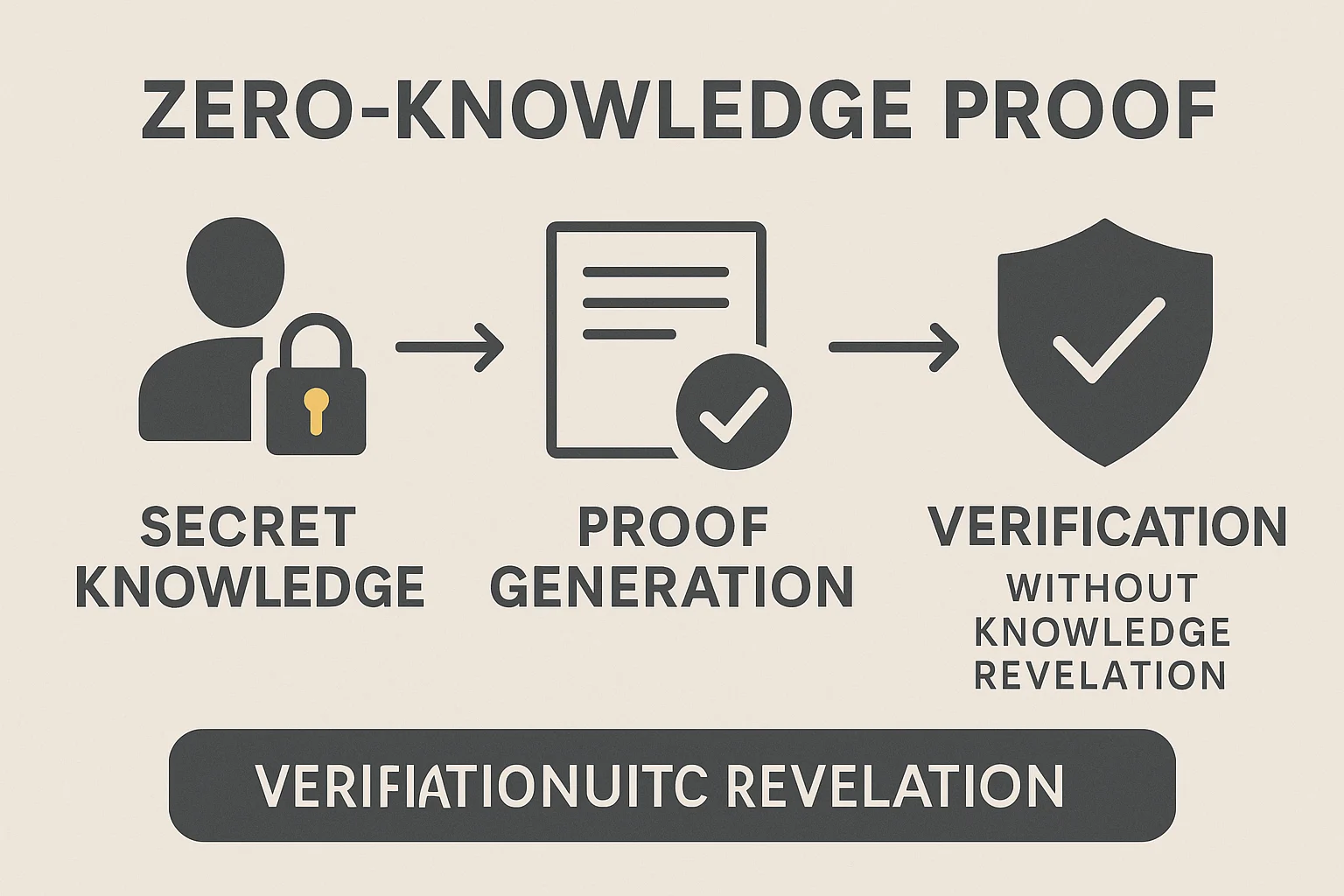
Infographic showing the zero-knowledge proof process: secret knowledge, proof generation, and verification without revealing the underlying data

Real-World Examples

  • Zcash transactions use zk-SNARKs to prove transaction validity without revealing amounts or addresses
  • Polygon Hermez uses zero-knowledge rollups for scalable Ethereum transactions
  • Age verification systems prove you’re over 18 without revealing your exact age or birthday

Why Beginners Should Care

Privacy revolution potential exists as ZKPs enable verification systems that don’t require sharing sensitive personal or financial information.

Scalability solutions like zk-rollups use zero-knowledge proofs to batch thousands of transactions while maintaining security and reducing costs.

Technical complexity makes ZKPs challenging to implement correctly, but user-facing applications hide this complexity behind simple interfaces.

Related Terms: Privacy Coin, zk-SNARKs, zk-STARKs, Rollups

Back to Crypto Glossary

Similar Posts

  • Hash Function

    Hash Function: One-Way Mathematical TransformationHash functions are mathematical algorithms that convert input data into fixed-size output strings in a way that's easy to compute forward but practically impossible to reverse. They're like digital fingerprints for data.A hash function is a mathematical algorithm that takes input data of any size and produces a fixed-size output (hash)…

  • Validator Jailing

    Validator Jailing: Temporary Network Punishment Validator jailing temporarily removes misbehaving validators from consensus participation while allowing them to return after penalties. It’s like being sent to the penalty box in hockey. Validator jailing is a punishment mechanism that temporarily excludes validators from consensus participation and rewards due to violations like extended downtime or rule infractions….

  • Public Ledger

    Public Ledger: Transparent Transaction Records Public ledgers record all transactions transparently where anyone can verify the complete history of asset movements. It’s like having a bank statement that everyone can read but no one can forge. A public ledger is a distributed database that records all transactions transparently, allowing anyone to verify and audit the…

  • HODL

    HODL: The Art of Doing Nothing HODL started as a typo but became crypto’s most important investment strategy. Sometimes the best move is not moving at all. HODL means holding cryptocurrency long-term regardless of short-term price volatility, derived from a misspelled “hold” in a 2013 Bitcoin forum post. It represents the strategy of buying and…

  • Digital Signature

    Digital Signature: Cryptographic Identity ProofDigital signatures provide mathematical proof of message authenticity and sender identity using cryptographic techniques. They're like unforgeable electronic signatures that prove who sent what.A digital signature is a cryptographic mechanism that verifies the authenticity of digital messages or documents and confirms the identity of the sender. Digital signatures are fundamental to blockchain…

  • Back Running

    Back Running: Following Profitable TransactionsBack running involves placing transactions immediately after profitable transactions to capture secondary opportunities. It's like following successful traders to pick up the crumbs they leave behind.Back running is a MEV extraction strategy where bots place transactions immediately after profitable transactions to capture residual value or secondary opportunities. This technique exploits the predictable…