
Wallet Drainer

Wallet Drainer: Malicious Fund Extraction

Wallet drainers are malicious smart contracts or applications designed to steal all assets from connected wallets through deceptive transaction approvals. They’re digital pickpockets with smart contract superpowers.

A wallet drainer is malicious software that tricks users into signing transactions that grant unlimited access to their cryptocurrency holdings. These attacks often disguise themselves as legitimate applications or NFT mints to gain user trust.

How Wallet Drainers Work

Social engineering presents fake websites, NFT mints, or airdrops that appear legitimate to trick users into connecting their wallets.

Malicious approvals request permissions that seem reasonable but actually grant unlimited access to users’ token holdings across multiple assets.

Automated extraction immediately drains approved tokens once users sign the malicious transactions, often faster than users can realize what happened.
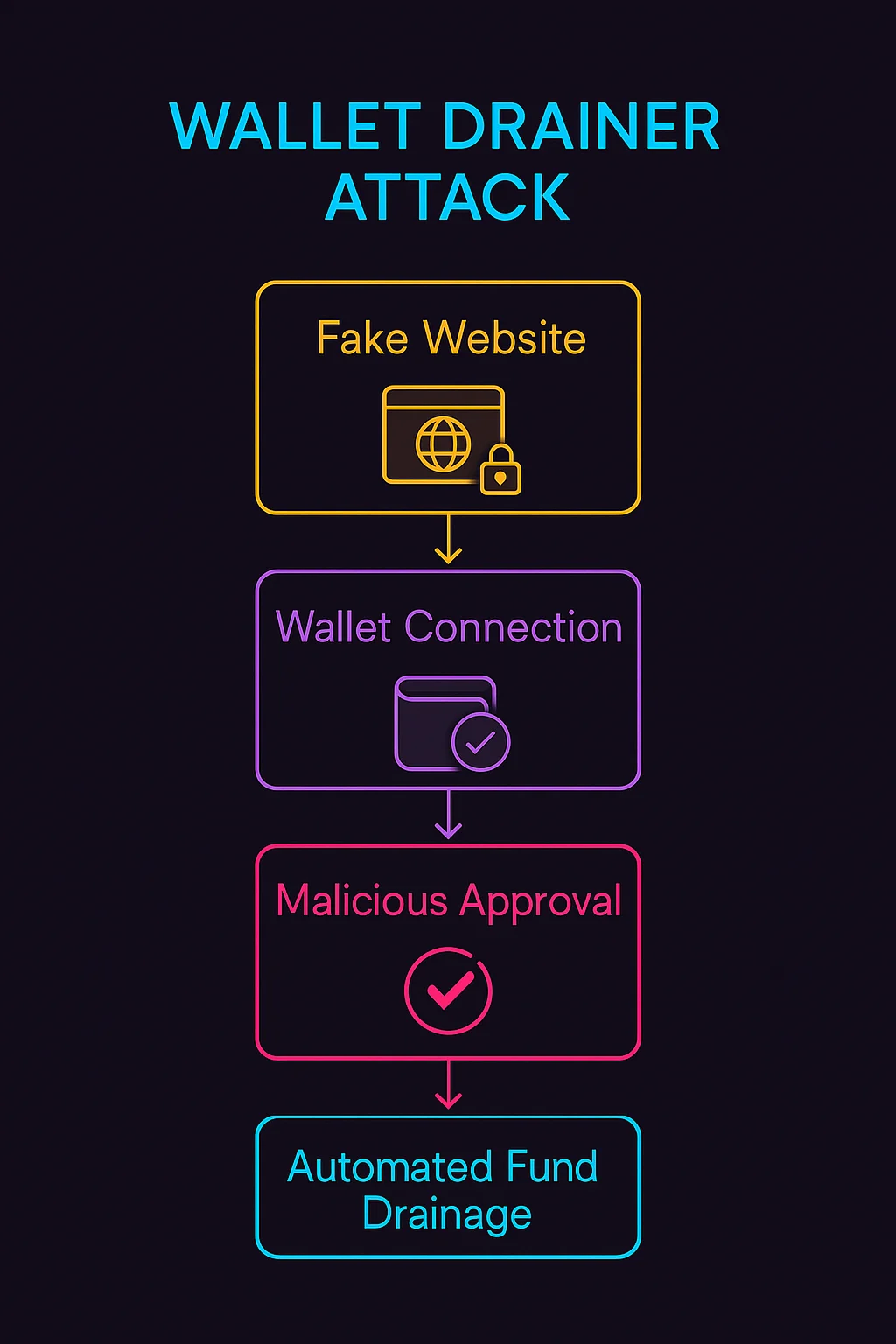
Infographic showing wallet drainer attack sequence: fake website, wallet connection, malicious approval, and automated fund drainage

Real-World Examples

  • Fake NFT mint sites that drain wallets when users attempt to mint seemingly legitimate collections
  • Phishing websites mimicking popular DeFi protocols to steal user approvals
  • Malicious browser extensions that inject drainer code into legitimate websites

Why Beginners Should Care

Irreversible losses since blockchain transactions cannot be reversed once confirmed, making wallet drainer attacks permanently damaging.

Prevention strategies include carefully verifying website URLs, understanding transaction approvals, and using hardware wallets for additional security.

Growing sophistication as drainer attacks become more convincing and harder to detect, requiring increased vigilance from all crypto users.

Related Terms: Phishing Attack, Transaction Approval, Social Engineering, Hardware Wallet

Back to Crypto Glossary

Similar Posts

  • Liquidity Pool

    Liquidity Pool: The Fuel That Powers DEX Trading Liquidity pools are why decentralized exchanges work. They’re shared pots of tokens that enable trading without traditional buyers and sellers. A liquidity pool is a collection of tokens locked in a smart contract that provides liquidity for decentralized trading. Instead of matching buy and sell orders, traders…

  • Protocol Revenue

    Protocol Revenue: Earning from Network ActivityProtocol revenue refers to income generated by blockchain protocols through transaction fees, service charges, or other value capture mechanisms. It's like toll roads that collect fees from everyone who uses the infrastructure.Protocol revenue encompasses all income streams generated by blockchain protocols including transaction fees, service charges, governance fees, and other…

  • EigenLayer

    EigenLayer: Ethereum Restaking ProtocolEigenLayer enables Ethereum validators to restake their ETH to secure additional protocols and earn extra rewards. It's like using the same security deposit to protect multiple different services simultaneously.EigenLayer is a protocol that allows Ethereum validators to restake their staked ETH to provide security for additional protocols and services beyond Ethereum itself. This…

  • Layer 2

    Layer 2: Scaling Solutions for Expensive Blockchains Layer 2 networks solve Ethereum’s biggest problem – ridiculous gas fees. They process transactions cheaply and quickly while inheriting Ethereum’s security. Layer 2 is a separate blockchain or protocol built on top of a main blockchain (Layer 1) to improve scalability and reduce transaction costs. These solutions handle…

  • Exploit

    Exploit: Taking Advantage of VulnerabilitiesAn exploit is an attack that takes advantage of vulnerabilities in smart contracts or protocols to steal funds or manipulate systems. It's like finding a secret backdoor in a building.An exploit refers to successfully taking advantage of vulnerabilities, bugs, or design flaws in smart contracts, protocols, or systems to extract value…

  • Token Emissions

    Token Emissions: New Cryptocurrency CreationToken emissions refer to the creation and distribution of new cryptocurrency tokens over time according to predetermined schedules. It's like a factory that produces new money at controlled rates rather than printing it all at once.Token emissions describe the systematic creation and release of new cryptocurrency tokens into circulation according to…