
Yield Farming

Yield Farming: Crypto’s High-Risk, High-Reward Game

Yield farming is DeFi’s answer to traditional investing – except the yields are higher, the risks are bigger, and the game changes daily.

Yield farming is the practice of lending, staking, or providing liquidity with your cryptocurrency to earn maximum returns across multiple DeFi protocols. It’s like playing musical chairs with your money, constantly moving to wherever yields are highest.

How Yield Farming Works

Farmers deploy capital across different DeFi protocols to maximize returns. This might involve providing liquidity to DEXs, lending on money markets, or staking governance tokens.

Strategy matters. Smart farmers compound their rewards, reinvesting earnings to grow their positions. They also chase new opportunities as yields shift between protocols.

Advanced farmers use leverage, borrowing against collateral to increase their farming positions. This amplifies both gains and losses dramatically.
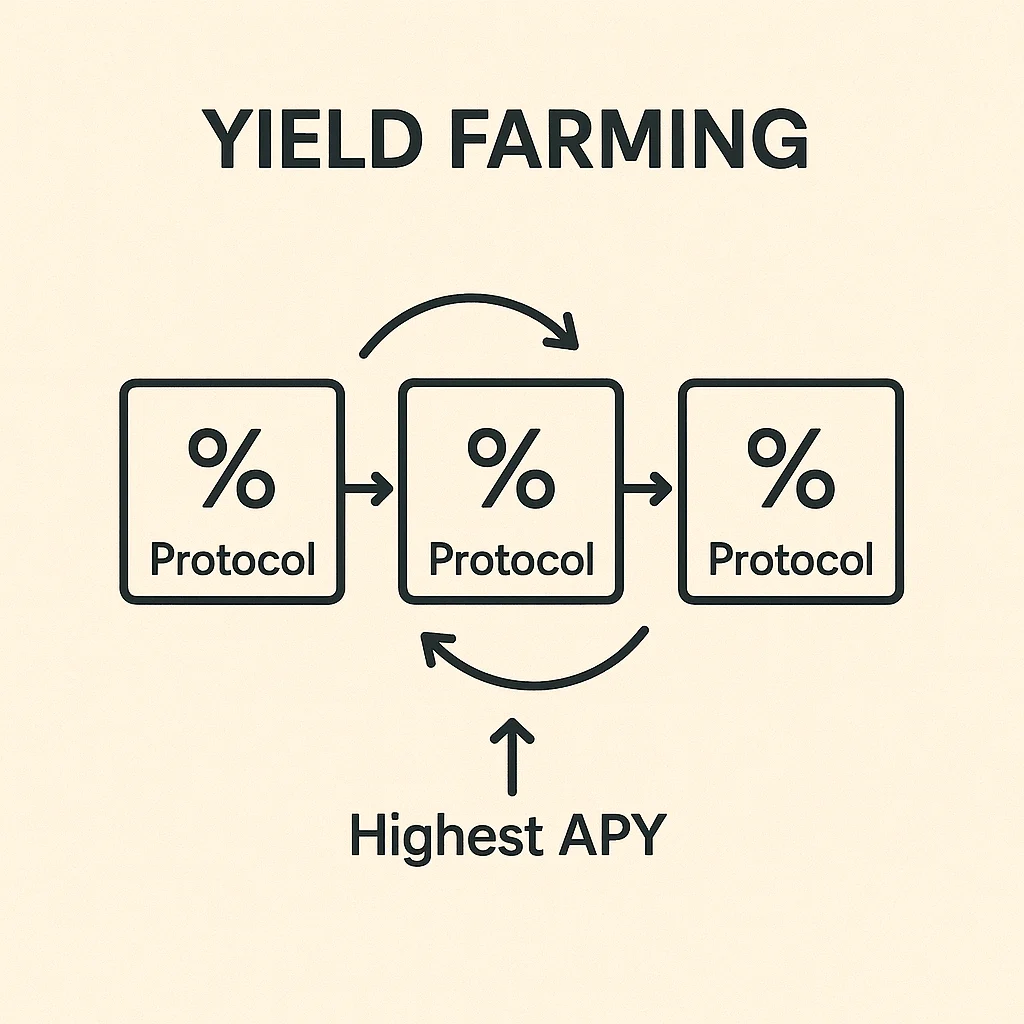
Flowchart showing a yield farming strategy with capital moving between protocols seeking the highest APY

Real-World Examples

  • Compound – Lend USDC at 5% APY, earn COMP tokens worth another 3%
  • Curve – Provide stablecoin liquidity for 8% base APY plus CRV rewards
  • Convex – Boost Curve yields through optimized staking strategies

Why Beginners Should Care

Yield farming can generate impressive returns – 20-100%+ APY isn’t uncommon during bull markets. But these protocols are experimental and uninsured.

Smart contracts can have bugs. Tokens can lose value overnight. Regulations can change. Only farm with money you can afford to lose completely.

Related Terms: Liquidity Pool, Staking, DeFi, Impermanent Loss

Back to Crypto Glossary

Similar Posts

  • Price Impact

    Price Impact: Trade Size Effect on Market PricesPrice impact refers to how trading activity affects cryptocurrency prices, particularly when large orders move markets significantly. It's like how jumping into a small pool creates bigger waves than jumping into an ocean.Price impact is the effect that trading activity has on cryptocurrency prices, with larger trades typically…

  • Exploit

    Exploit: Taking Advantage of VulnerabilitiesAn exploit is an attack that takes advantage of vulnerabilities in smart contracts or protocols to steal funds or manipulate systems. It's like finding a secret backdoor in a building.An exploit refers to successfully taking advantage of vulnerabilities, bugs, or design flaws in smart contracts, protocols, or systems to extract value…

  • Execution Environment

    Execution Environment: Runtime for Smart ContractsAn execution environment provides the runtime infrastructure where smart contracts and decentralized applications operate. It's like the operating system that runs your computer programs.An execution environment is the runtime infrastructure that executes smart contracts and processes transactions on blockchain networks. This environment defines how code runs, what resources are available, and…

  • Sharding

    Sharding: Splitting Networks for Speed Sharding divides blockchain networks into smaller pieces that process transactions in parallel. It’s like adding more checkout lanes at the grocery store – same capacity, faster service. Sharding is a scaling technique that splits a blockchain network into smaller, parallel chains called shards that process transactions independently. Each shard handles…

  • Protocol

    Protocol: Blockchain Network RulesA protocol is the set of rules and standards that govern how a blockchain network operates. It's like the constitution of a country that defines how the government works, what's allowed, and how decisions are made.A protocol refers to the comprehensive set of rules, standards, and procedures that define how a blockchain…

  • Modular Blockchain

    Modular Blockchain: Specialized Building Blocks Modular blockchains separate core functions like consensus, execution, and data availability into specialized layers. It’s like having a restaurant where different teams handle cooking, serving, and cleaning instead of one person doing everything. Modular blockchain architecture separates blockchain functions into distinct layers that can be optimized independently. This allows specialization…